How To Make Liquid Laundry Detergent – Pro Tips
To make liquid laundry detergent, start by heating 6 cups of distilled water and dissolving 1 cup each of borax and washing soda thoroughly. Once cooled, add 1 cup of liquid castile soap carefully to minimize suds, especially for HE machines.
Incorporate up to 50 drops of essential oil after cooling to maintain fragrance. Use distilled water for consistency, shake before each use, and dose 1-2 tablespoons for front-loaders. Keep it airtight to preserve freshness.
Further refinement tips will help optimize your detergent’s performance.
Key Takeaways
- Heat 6 cups distilled water, then dissolve 1 cup each of borax and washing soda while stirring continuously.
- Add 1 cup liquid castile soap after cooling, limiting to 1-2 tablespoons per load for HE machines to reduce suds.
- Incorporate up to 50 drops of essential oils only after detergent cools for 5-10 minutes for balanced fragrance.
- Use distilled water exclusively and adjust water amount (10-12 cups) for desired detergent thickness and consistency.
- Store detergent in airtight containers, shake or stir before each use, and dose properly to ensure consistent performance.
Gather Ingredients for Homemade Laundry Detergent

To make your homemade liquid laundry detergent, start by gathering precise quantities of key ingredients: 1 cup each of washing soda, borax, and liquid castile soap. These components form the detergent’s effective cleaning base.
Begin your homemade liquid laundry detergent by measuring 1 cup each of washing soda, borax, and castile soap.
Next, prepare 13 cups of distilled water to dilute the mixture, optimizing its performance and preventing contamination. Optionally, you can add about 50 drops of essential oil to customize the scent.
Make sure you have a large saucepan or Dutch oven to handle the heating process safely and storage jars, preferably glass mason jars, for preserving the finished detergent.
Using distilled water is critical for maintaining detergent purity and consistency.
Heat and Dissolve Borax and Washing Soda for Detergent
Begin by heating 6 cups of distilled water to a low boil in a large saucepan or Dutch oven.
Once the boiling water reaches the correct temperature, add 1 cup of borax and 1 cup of washing soda simultaneously.
Stir continuously to guarantee both ingredients fully dissolve, preventing any undissolved particles that could compromise the homemade detergent’s effectiveness.
Maintaining a consistent heat while stirring helps achieve a homogeneous solution, essential for uniform cleaning performance.
Using distilled water eliminates contaminants that might interfere with the detergent’s chemical balance.
After confirming the borax and washing soda are completely dissolved and the mixture is well mixed, allow it to cool slightly before incorporating other ingredients.
This precise heating and dissolving step forms the detergent’s foundational solution, optimizing its cleaning power.
Add Liquid Castile Soap Without Creating Excess Suds

While incorporating liquid castile soap into your detergent mixture, you’ll want to carefully control the amount to prevent excessive suds, especially if you use a high-efficiency (HE) washing machine. Limit liquid castile soap to 1-2 tablespoons per load to avoid sudsing issues common in HE machines.
Use only 1-2 tablespoons of liquid castile soap per load to prevent excess suds in HE washers.
Combine the soap with washing soda and borax dissolved in boiling water to guarantee proper dissolution and minimize suds formation. Use distilled water to enhance detergent stability and reduce suds caused by impurities.
Maintain balanced water content to dilute the soap adequately, preventing a thick solution that promotes excess suds.
Always shake or stir your detergent before use to redistribute natural ingredients, ensuring consistent performance and controlled sudsing during washing cycles.
This method optimizes cleaning efficiency without compromising your HE machine.
Choose the Best Water for Your Laundry Detergent
Controlling suds with liquid castile soap sets the stage for selecting the right water to maximize your detergent’s performance.
Opt for distilled water in your homemade laundry detergent to eliminate contaminants and guarantee uniform ingredient mixing.
Hard water, rich in minerals, reduces detergent performance by causing soap scum buildup on fabrics and machines. This buildup impairs cleaning efficacy.
Monitor your water’s pH level; alkaline conditions enhance microbial inhibition within the detergent.
If you face hard water, incorporate a water softener to mitigate mineral interference and optimize cleaning results.
Adjust your detergent formula based on mineral content to maintain efficacy.
Add Essential Oils Without Losing Scent

You want to add essential oils only after the detergent has cooled down. This helps prevent the oils from evaporating since their volatile compounds are pretty sensitive to heat.
If you add the oils too early, you’ll lose a lot of the scent, and the fragrance won’t be as strong.
Timing For Adding Oils
Because essential oils evaporate quickly when exposed to heat, adding them immediately after the detergent cools for 5 to 10 minutes preserves their fragrance.
Timing is vital to maintain the scent integrity in your detergent mixture.
After cooling, incorporate about 50 drops of essential oils per gallon to achieve a balanced fragrance without overpowering it.
Stir thoroughly to guarantee even distribution throughout the liquid.
Using scented liquid castile soap as a base can further enhance the overall scent profile.
You can customize the fragrance by experimenting with different essential oils or blends, adjusting drop counts based on scent strength.
Proper timing and mixing optimize scent retention and uniformity, assuring your homemade liquid laundry detergent delivers consistent, long-lasting aroma in every wash.
Preventing Essential Oil Evaporation
Although essential oils add a pleasant fragrance to your detergent, their volatile nature requires careful handling to prevent evaporation and scent loss. To maximize fragrance potency, add essential oils only after the detergent mixture has cooled for 5-10 minutes. Use a maximum of 50 drops per batch to maintain a balanced scent without compromising detergent effectiveness.
Choose oils with lower volatility, such as patchouli or cedarwood, to reduce evaporation risk. Store the finished detergent in airtight containers to minimize exposure to air, which accelerates scent degradation.
Before each use, stir or shake the detergent to distribute essential oils evenly, ensuring a consistent fragrance.
- Add essential oils post-cooling to preserve fragrance potency
- Use airtight containers to prevent evaporation from exposure to air
- Stir detergent before use for balanced scent and consistent fragrance
How to Adjust Detergent Thickness and Consistency
You’ll want to keep an eye on detergent separation, so give it a good shake or stir before each use to keep the consistency nice and even.
If you’re aiming to thicken the mixture, try cutting down on the amount of water you add. Using distilled water instead of tap water can also make a difference.
Another trick is to tweak the salt concentration carefully—it can help thicken things up without messing with the cleaning power.
Oh, and if you have an immersion blender handy, blending the detergent can really improve the texture. Plus, it won’t affect how well it cleans, which is always a win!
Managing Detergent Separation
When managing detergent separation, controlling the water quality and quantity is essential to achieving the right thickness and consistency. Use distilled water to prevent contaminants that disrupt your homemade detergent’s uniformity.
If the detergent appears too watery, reduce water from 15 cups to 10-12 cups for a thicker product.
Clumping or separation can occur, so employ an immersion blender to restore a smooth texture. Always shake or stir the detergent before each use to redistribute ingredients evenly.
Store your detergent in airtight containers to maintain consistency and minimize separation over time.
Use distilled water exclusively to guarantee purity and stable consistency. Adjust water volume precisely for desired thickness without compromising performance.
Utilize an immersion blender to fix clumping and maintain a homogeneous mixture.
Techniques To Thicken
Controlling water quality and quantity sets the foundation for your detergent’s consistency, but fine-tuning thickness requires specific techniques.
To thicken your homemade liquid laundry soap, use distilled water to prevent separation and enhance viscosity.
Gradually add salt to increase thickness without compromising cleaning power.
Employ an immersion blender to create a uniform, gel-like consistency.
Reducing water volume produces a more concentrated detergent, while allowing the mixture to sit for 24 hours lets it gel naturally.
Store Detergent for Maximum Freshness
Although homemade liquid laundry detergent is effective when freshly made, proper storage is crucial to maintaining its potency and freshness. To store detergent efficiently, use airtight containers, preferably glass jars, to prevent plastic leaching and contamination.
Proper storage in airtight glass containers preserves the freshness and effectiveness of homemade liquid laundry detergent.
Keep the detergent at room temperature, away from direct sunlight, to maximize its shelf life of about one month. Always verify containers are sealed tightly after each use to reduce air exposure, which degrades effectiveness.
For larger batches, use a 5-gallon bucket with a lid for bulk storage, while smaller containers serve daily use. Monitor the detergent’s consistency regularly. If separation occurs, give it a good shake before use to guarantee even distribution of ingredients.
- Store detergent in airtight containers, preferably glass jars.
- Keep sealed tightly and away from sunlight.
- Shake well to maintain consistent texture and performance.
Use the Right Dosage for Your Washing Machine
Because different washing machines require specific detergent amounts, using the right dosage guarantees ideal cleaning and prevents mechanical issues.
For top-loading machines, apply 1/8 to 1/4 cup of homemade liquid laundry detergent per load.
HE front-loading machines need a smaller quantity, 1 to 2 tablespoons, to avoid excessive suds that could damage hoses.
Each gallon of your detergent produces about 64 loads, making it cost-effective at roughly $0.08 per load.
Before dosing, always shake or stir the detergent thoroughly to counteract ingredient separation that affects concentration.
If you use borax and washing soda in HE machines, adjust their amounts carefully to prevent buildup.
Precise dosing optimizes cleaning performance, protects your washing machine, and maximizes the cost-efficiency of your homemade detergent.
Fix Common Laundry Detergent Problems
Maintaining the right detergent dosage helps prevent many common issues, but homemade liquid laundry detergent can still present challenges like separation, watery consistency, or excessive suds.
To fix these common laundry detergent problems, you should:
To fix common laundry detergent problems, simple adjustments and proper preparation can ensure better performance and consistency.
Use distilled water to reduce watery consistency and improve the detergent’s thicker texture.
Shake or stir the homemade laundry soap before each use to re-emulsify separated ingredients.
In hard water areas, add white vinegar during the rinse cycle to prevent soap scum and enhance cleaning performance.
Additionally, employing an immersion blender can create a uniform, thicker texture in your liquid laundry detergent.
Adjust washing soda and borax amounts for HE machines to minimize suds.
These technical adjustments guarantee your homemade liquid laundry detergent performs efficiently and consistently.
Frequently Asked Questions
Can I Use Liquid Detergent for Hand Washing Clothes?
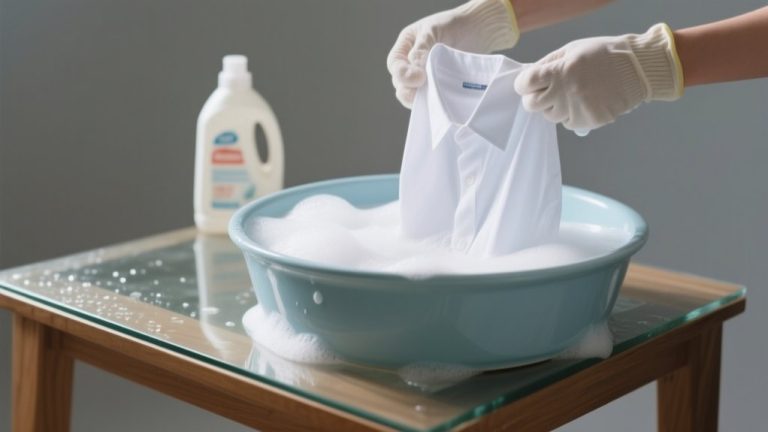
Yes, you can use liquid detergent for hand washing clothes. Dilute 1-2 tablespoons in a basin with lukewarm water to avoid excessive suds and guarantee effective cleaning.
Check the detergent’s compatibility with your fabric to prevent damage. Make sure it dissolves completely for ideal fiber penetration.
After washing, rinse thoroughly to remove all residues, preventing irritation or fabric stiffness.
This method guarantees precise, efficient cleaning by enhancing detergent concentration and water temperature.
How Long Does Homemade Detergent Last Before Expiring?
You might think homemade detergent lasts indefinitely, but it typically remains effective for about 30 days at room temperature.
Over time, it can separate or thin, which is normal. You just need to shake it.
Store it in airtight glass containers to prevent chemical leaching and spoilage.
If you notice mold or a strange odor, discard it immediately.
Using it within this timeframe guarantees peak cleaning power and safety.
Is Homemade Detergent Safe for Sensitive Skin?
Yes, homemade detergent is safe for sensitive skin because it avoids harsh chemicals and synthetic fragrances. When you use castile soap, borax, and washing soda, you minimize irritants that often cause allergic reactions.
You can also customize the formula by omitting essential oils or using mild ones, reducing the risk further.
This controlled ingredient profile guarantees a gentle, hypoallergenic cleaning agent, making it ideal if you’re prone to skin sensitivities or allergies.
Can I Add Fabric Softener to Homemade Laundry Detergent?
You shouldn’t add fabric softener directly to homemade laundry detergent because it can reduce cleaning effectiveness and leave residues.
Instead, add a rinse cycle product like vinegar, which naturally softens fabrics without interfering with detergent performance.
If you want scent, use essential oils separately.
This approach maintains detergent efficiency while softening clothes, avoiding chemical conflicts that degrade cleaning power or cause buildup on fabrics.
What Are Eco-Friendly Alternatives to Borax and Washing Soda?
You can replace borax and washing soda with eco-friendly alternatives like baking soda, which softens water and deodorizes without harsh chemicals.
White vinegar serves as a multifunctional substitute, softening fabrics and breaking down stains.
Castile soap offers gentle, biodegradable cleansing.
Citric acid brightens whites, removes stains, and reduces mineral buildup.
Furthermore, natural mineral salts or sodium carbonate provide effective cleaning while minimizing environmental impact and skin irritation.
Conclusion
Now that you’ve mastered each precise step, from dissolving borax to balancing detergent thickness, your homemade liquid laundry detergent is almost ready. But before you start, consider this: a single misstep in water choice or essential oil addition can drastically alter effectiveness.
Will your detergent deliver the ideal clean, or will hidden variables undermine your effort? The final challenge lies in perfecting the dosage and storage. Get these right, and you’ll access truly superior laundry results.