How Does Laundry Detergent Work – Overview
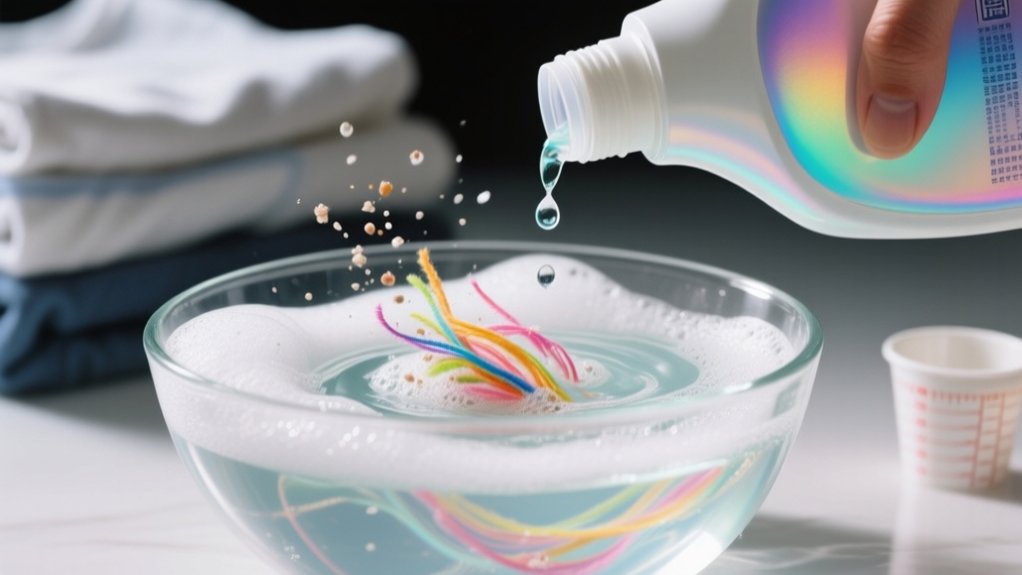
Laundry detergent works by combining surfactants, enzymes, and builders that target dirt, grease, and stains through chemical and mechanical action. Surfactants lift and trap oils, enzymes break down proteins and starches, and builders soften water to boost performance.
Your washing machine’s agitation and heat activate these components, ensuring efficient cleaning. Different formulations, like powder or liquid, optimize performance under varying conditions.
Exploring the full process reveals how these elements interact to achieve effective, eco-conscious cleaning.
Key Takeaways
- Surfactants in detergents form micelles that trap and remove dirt and grease from fabrics for easy rinsing.
- Builders enhance cleaning by softening hard water and preventing surfactant neutralization, improving detergent efficiency.
- Enzymes break down protein, fat, and starch stains, enabling effective cleaning at lower temperatures.
- Mechanical agitation and heat in washing machines activate detergents and help dislodge dirt from fabric fibers.
- Anti-redeposition agents keep dirt suspended in water to prevent it from settling back onto clothes during washing.
What Laundry Detergent Is Made Of
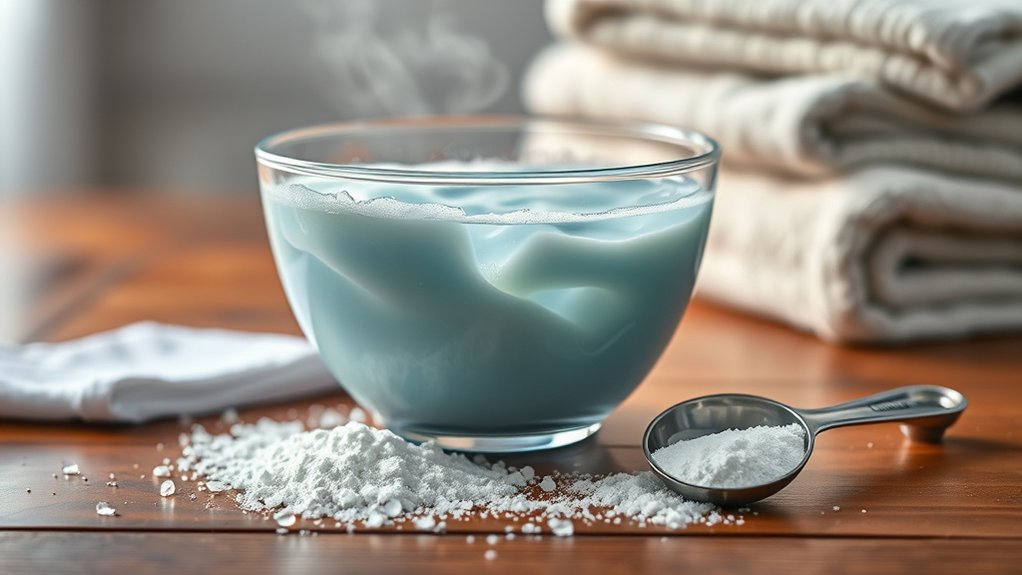
Laundry detergent consists of several key components designed to work together for effective cleaning. Surfactants serve as the primary agents, possessing hydrophilic heads and hydrophobic tails that facilitate dirt and grease removal from fabrics.
Builders, like sodium tripolyphosphate and zeolites, enhance cleaning power by sequestering calcium and magnesium ions found in hard water, preventing interference with surfactant activity.
Enzymes including proteases, lipases, and amylases target specific stains by breaking down proteins, fats, and starches, respectively, increasing detergent efficiency.
Bleaching agents such as hydrogen peroxide and optical brighteners whiten fabrics by oxidizing stains or absorbing ultraviolet light.
Together, these components maximize the laundry detergent’s overall performance, ensuring thorough stain removal and fabric brightness while maintaining formulation stability and preventing soil redeposition during washing.
How Laundry Detergent Surfactants Remove Dirt and Grease
You’ll notice that surfactants have a dual structure. They’ve hydrophobic tails that attract grease, and hydrophilic heads that bond with water.
When you agitate the detergent in water, these molecules come together and form micelles. These micelles trap dirt and oil right in their cores.
This molecular setup is what helps lift and suspend stains so they rinse away easily.
Surfactant Molecular Structure
Surfactants are molecules designed with dual characteristics: a hydrophobic tail that attracts grease and oils, and a hydrophilic head that bonds with water. These surfactant molecules use their hydrophobic tails to latch onto oily dirt, while their hydrophilic heads remain soluble in water, enabling effective dirt removal.
Anionic surfactants, with their strong negative charge, excel at breaking down and lifting stains by destabilizing grease particles. Furthermore, surfactants reduce surface tension in water, allowing it to better penetrate fabric fibers and improve cleaning efficiency.
While micelle formation is essential for trapping grease, the molecular structure itself, balancing hydrophobic tails and hydrophilic heads, fundamentally drives the detergent’s ability to emulsify and suspend dirt. This ensures thorough cleaning during the wash cycle.
Micelle Formation Process
Although dirt and grease cling stubbornly to fabric fibers, the micelle formation process enables detergents to effectively remove them. Surfactants in laundry detergent have hydrophobic tails that bind to grease and oils while their hydrophilic heads stay attracted to water.
When agitated in water, surfactants self-assemble into micelles, spherical aggregates that encapsulate dirt within their hydrophobic cores. This encapsulation isolates dirt from fabrics, making removal easier during rinsing.
The efficiency of micelle formation, and therefore cleaning, improves with temperature because warmer water helps surfactants penetrate fabric fibers better. Anionic surfactants target negatively charged soils, while nonionic types focus on organic dirt, which ensures thorough cleaning.
Modern detergents optimize surfactant concentration to enable micelle formation even in cold water. This keeps dirt removal effective while caring for your fabrics.
How Laundry Detergent Enzymes Break Down Stains
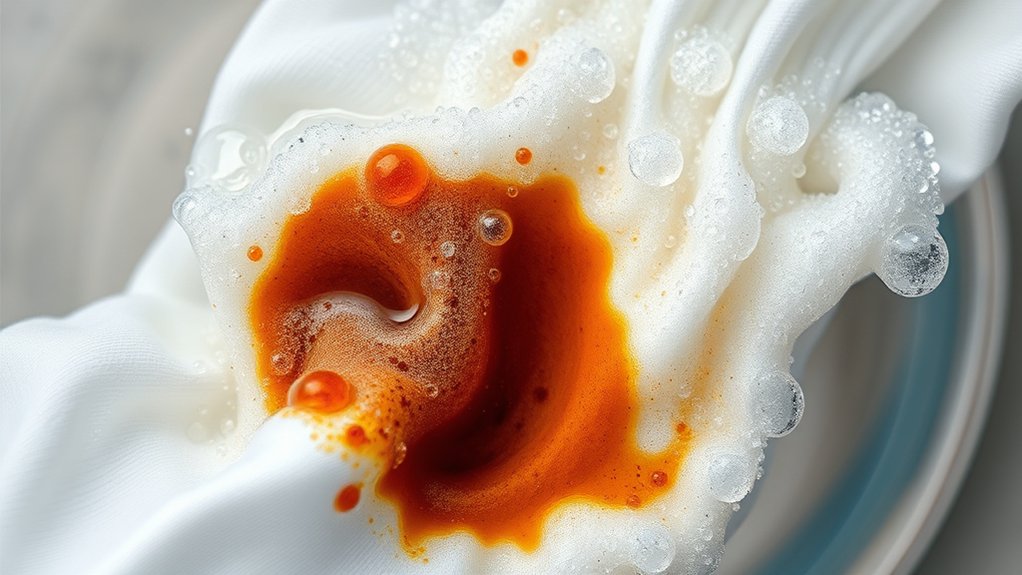
Because enzymes target specific stain components, they play an essential role in breaking down stains during laundry. Enzymes such as proteases, amylases, and lipases each act on distinct stain types: proteases hydrolyze protein-based stains like blood, amylases catalyze the breakdown of starch-based residues, and lipases degrade fats and oils.
Enzymes precisely target and break down protein, starch, and fat stains for effective laundry cleaning.
These biochemical catalysts accelerate stain decomposition at the molecular level, enhancing cleaning efficiency considerably. By optimizing enzymatic activity, detergents achieve effective stain removal even at lower temperatures, reducing reliance on harsh chemicals.
This targeted action not only improves stain elimination but also contributes to energy savings and environmental sustainability.
Ongoing research expands enzyme varieties, further refining detergent performance across diverse stains and fabric types, ensuring precise and efficient stain removal.
Why Detergent Builders Matter for Hard Water Cleaning
You rely on detergent builders because they act like chelating agents that grab onto calcium and magnesium ions found in hard water.
This is important because these minerals can otherwise neutralize surfactants, which are the cleaning powerhouses in your detergent.
By binding to these ions, detergent builders help surfactants stay effective.
That means they can better penetrate fabric fibers and lift away dirt and stains.
Without these builders, hard water minerals would interfere with the detergent’s performance and leave more residue on your clothes.
Role Of Chelating Agents
Chelating agents like EDTA and sodium gluconate play a critical role in tackling hard water challenges during laundry. They bind with metal ions such as calcium and magnesium, which otherwise reduce surfactant effectiveness by forming insoluble salts.
By sequestering these ions, chelating agents prevent interference with surfactants, enhancing detergents’ cleaning power. This action increases surfactant solubility, allowing you to use less detergent while maintaining performance, which also lowers environmental impact.
Furthermore, chelating agents inhibit mineral buildup on fabrics, preserving fabric integrity and appearance.
Studies show that including chelating agents in detergent formulations can improve cleaning performance by up to 30% in hard water conditions compared to detergents lacking these agents.
Consequently, chelating agents are indispensable for optimizing detergent efficiency when washing in hard water.
Enhancing Surfactant Efficiency
When hard water introduces calcium and magnesium ions into the wash, detergent builders like sodium tripolyphosphate (STTP) and zeolites bind these minerals. This prevents interference with surfactants and enhances their efficiency, boosting stain removal and overall detergent performance.
Builders soften hard water, allowing surfactants to penetrate fabrics and lift dirt effectively. They also reduce soap scum formation, which would otherwise impair cleaning efficacy.
Here’s why builders matter for hard water cleaning:
- They sequester hard water ions, preventing surfactant deactivation.
- They improve stain removal by maintaining surfactant activity.
- They enhance detergent performance, reducing product usage and improving wash quality.
How Washing Machines and Detergents Work Together
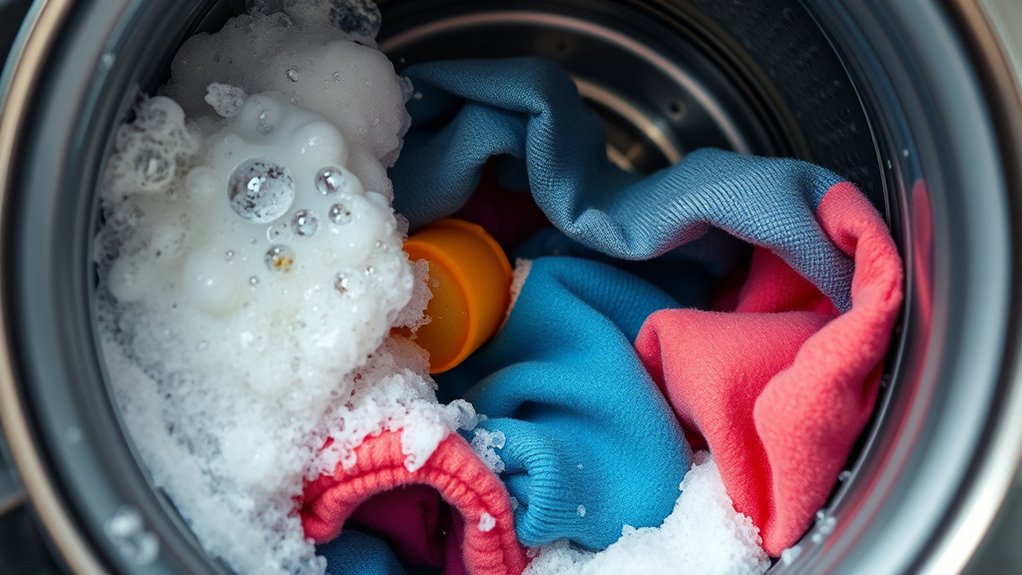
Although detergents contain powerful cleaning agents, they rely on washing machines’ mechanical agitation to maximize effectiveness. When you run a laundry cycle, washing machines generate agitation that physically dislodges dirt particles from fabric fibers.
This movement allows surfactants in detergents to penetrate deeper, lowering water’s surface tension and enabling oils and grease to be encapsulated within micelles. The synergy between agitation and surfactants guarantees efficient dirt lift and suspension for rinsing.
Moreover, heat enhances detergent solubility and enzyme activation, further optimizing cleaning performance.
You must also dose detergents accurately; insufficient amounts reduce cleaning efficiency, while overdosing causes excessive sudsing, impairing rinsing and leaving residues.
How Detergents Stop Dirt From Resettling on Clothes
You know those anti-redeposition agents in detergents? They’re really important because they keep dirt particles floating around in the water instead of letting them settle back onto your clothes during rinsing. It’s like they act as little bodyguards for your fabrics.
A big part of how this works comes down to the charges on surfactants. These charges help stabilize micelles, which are tiny clusters that trap dirt and oil.
By keeping the dirt safely inside these micelles, the particles stay separated from the fabric fibers.
Once you understand these details, it’s easier to see how detergents manage to keep your clothes clean throughout the whole wash cycle. It’s a clever system that makes sure dirt doesn’t sneak back onto your favorite outfits.
Anti-Redeposition Agents
Since lifted dirt particles tend to resettle on fabrics during washing, detergents incorporate anti-redeposition agents to prevent this occurrence. These agents enhance the performance of detergents by maintaining dirt in suspension. This ensures effective removal of dirt and helps clean your clothes thoroughly.
Anti-redeposition agents commonly include synthetic polymers and surfactants that form a barrier around soil particles.
Key functions of anti-redeposition agents include:
- Preventing dirt from reattaching to fabrics by keeping particles suspended in wash water.
- Enhancing detergent efficiency in heavily soiled loads, reducing the need for multiple wash cycles.
- Prolonging fabric lifespan by minimizing residual soil buildup.
Incorporating these agents is essential to optimize detergent formulations and achieve superior cleaning performance.
Surfactant Charge Interaction
Building on the role of anti-redeposition agents in keeping dirt suspended, surfactants actively prevent soil from resettling by leveraging their molecular structure and electric charge. Their hydrophilic heads attract water, while hydrophobic tails bind oils and dirt, forming micelles that encapsulate particles.
The electric charges on surfactants generate repulsive forces between dirt and fabric, enhancing anti-redeposition effects. This synergy, combined with washing machine agitation, keeps dirt suspended, ensuring thorough cleaning.
| Aspect | Effect |
|---|---|
| Hydrophilic Heads | Attract water, stabilize micelles |
| Hydrophobic Tails | Bind oils/dirt, form micelles |
| Electric Charges | Repel dirt, prevent redeposition |
Differences Between Powder and Liquid Laundry Detergents
Although both powder and liquid laundry detergents contain similar active ingredients like surfactants and enzymes, they differ considerably in formulation, application, and environmental impact.
When washing clothes, these differences influence efficiency and sustainability:
Powdered detergents typically include sodium sulfate as a filler and have improved solubility, minimizing residue issues.
Powdered detergents use sodium sulfate fillers and dissolve well, reducing leftover residue on clothes.
They’re more eco-friendly due to cardboard packaging, which reduces environmental impact.
Liquid laundry detergents consist of pre-dissolved ingredients that dissolve quickly, especially in cold water.
This enhances stain removal and makes them more effective in low-temperature washes.
The environmental impact favors powdered detergents because liquid detergents often come in plastic containers.
This increases CO2 emissions during production and disposal.
Understanding these distinctions helps you select the appropriate detergent based on washing conditions and ecological considerations.
Ingredients That Protect and Soften Fabrics
When you choose a laundry detergent, it’s important to evaluate ingredients that not only clean but also protect and soften your fabrics. Surfactants reduce friction during washing, which helps protect fabrics from wear.
Enzymes like proteases and lipases break down stains gently, preserving fiber integrity. Fabric softeners coat fibers to reduce static and maintain softness.
Chelating agents bind hard water minerals, ensuring surfactants work effectively to protect fabrics. Optical brighteners enhance fabric appearance by masking yellowing.
| Ingredient | Function |
|---|---|
| Surfactants & Enzymes | Remove dirt and stains while protecting fibers |
| Fabric Softeners | Reduce static, enhance softness |
| Chelating Agents & Optical Brighteners | Maintain cleaning efficiency and brighten fabric appearance |
Environmental Impact of Laundry Detergents
Since laundry detergents contribute greatly to environmental degradation, understanding their impact is essential. Detergents contain toxic ingredients that can cause eutrophication, severely damaging aquatic ecosystems.
Moreover, acidic wash water from detergents parallels acid rain effects, further stressing the environment. Regulatory limits on phosphate use aim to reduce waterway pollution caused by these chemicals.
When evaluating environmental impact, consider these factors:
- The average American family’s detergent use generates about 480 pounds of CO2 annually, increasing their carbon footprint.
- Toxic ingredients in conventional detergents harm aquatic life and disrupt ecosystems.
- Growing demand for environmentally friendly, biodegradable formulations drives the development of eco-friendly detergents.
How to Pick Eco-Friendly Laundry Detergents
How do you identify an eco-friendly laundry detergent that truly minimizes environmental harm? First, prioritize detergents labeled with recognized certifications like EPA Safer Choice, which verify safer chemical compositions and reduced aquatic toxicity.
Next, select products containing biodegradable ingredients to guarantee they break down efficiently in natural environments, mitigating pollution. Concentrated detergents offer additional benefits by reducing packaging waste and carbon emissions associated with transportation.
Avoid formulations containing phosphates, as these contribute to eutrophication, severely damaging aquatic ecosystems.
Finally, consider non-toxic formulations that decrease health risks for your household, especially if you have children or pets.
Frequently Asked Questions
Can Laundry Detergent Remove Pet Odors Effectively?
Yes, laundry detergent can effectively remove pet odors if you use the right formulation and technique.
Enzymes in detergents break down protein and fat-based stains from pet urine and dander, while surfactants lift odors from fabric fibers.
You’ll get better results with warm water to activate these ingredients and guarantee proper detergent dosage to avoid residue buildup.
Specialized odor neutralizers further enhance odor elimination for persistent smells.
How Does Detergent Work in Cold Water Washes?
Think of washing in cold water like a magician performing without heat. The trick still works but needs the right tools.
Your detergent uses specially engineered enzymes and surfactants that stay active at low temperatures, breaking down proteins and fats effectively.
By maintaining an alkaline pH between 7 and 11, the cleaning agents keep their chemical reactions efficient.
You might also want to soak clothes first, giving these agents more time to tackle tough stains.
Are Fragrance Additives Safe for Sensitive Skin?
Fragrance additives aren’t always safe for your sensitive skin. They can trigger allergic reactions or dermatitis, even at low concentrations regulated by authorities.
If you have sensitivities, you should opt for non-bio or fragrance-free detergents. These minimize irritation risks by excluding enzymes and artificial scents.
Always check labels carefully since individual reactions vary.
Choosing hypoallergenic products helps you avoid unwanted skin complications caused by fragrance compounds in standard detergents.
Can Detergent Cause Color Fading Over Time?
Yes, detergent definitely drives dye deterioration. Surfactants strip stains and simultaneously steal color molecules from fabric fibers.
Bleaching agents boost this breakdown by oxidizing dyes, especially in vivid or dark fabrics. Elevated temperatures enhance this effect by increasing dye solubility, accelerating leaching.
Enzymes, while effective at eradicating stains, can also erode dye structures. To safeguard your garments, select gentler, color-safe detergents and wash in cooler water to minimize fading over time.
How Should Detergent Be Stored for Best Performance?
You should store detergent in a cool, dry place away from direct sunlight to preserve its active ingredients.
Keep containers tightly sealed to prevent moisture absorption and clumping, which reduce effectiveness.
For liquids, always close caps securely to avoid spills and contamination.
Avoid areas with fluctuating temperatures or high humidity, as they degrade performance.
Finally, check expiration dates regularly.
Using expired detergent can greatly lower cleaning results.
Conclusion
You might not realize it, but over 85% of laundry detergent users rely on surfactants to break down oils and dirt effectively. Understanding how detergents combine surfactants, enzymes, and builders helps you choose the best product for your needs.
By selecting eco-friendly options, you not only protect your clothes but also reduce environmental impact. Armed with this knowledge, you can make smarter, more sustainable laundry decisions every time.