What Is In Oxiclean Powder – Ingredients Breakdown
If you’ve ever pulled laundry out of the wash only to find stubborn stains still hanging on, you’re not alone. Many people struggle with getting clothes truly clean, especially when everyday messes seem to set in for good. That’s why understanding what’s inside OxiClean powder can be so helpful.
OxiClean powder contains sodium percarbonate, which breaks down into hydrogen peroxide and soda ash to release oxygen, effectively removing stains through oxidative bleaching. Sodium carbonate raises alkalinity, enhancing stain removal and preventing soil redeposition. Surfactants lower surface tension, emulsifying oils and dirt for easier rinsing, while polymers stop particles from settling back onto fabrics. The formula excludes harsh bleaches and complies with safety and environmental standards. Explore how these components work together for powerful, eco-friendly cleaning.
What Are the Main Ingredients in OxiClean Powder?
The core cleaning power of OxiClean Powder comes from sodium percarbonate, which releases hydrogen peroxide when mixed with water. This active ingredient initiates the oxidation process essential for stain removal.
Sodium carbonate complements this by increasing the solution’s alkalinity, enhancing the breakdown of organic materials.
Surfactants play a critical role by lowering surface tension and emulsifying soils, allowing you to lift stains effectively from fabrics and surfaces.
Polymers are also incorporated to prevent re-deposition of loosened particles, maintaining fabric cleanliness throughout the wash cycle.
Together, these components form a synergistic system that addresses a broad spectrum of stains, from dirt to complex food residues.
Understanding this precise ingredient interplay helps you appreciate OxiClean’s formulation beyond just its stain-fighting reputation.
How Sodium Percarbonate Powers OxiClean Stain Removal
The next section explains how water temperature affects stain-lifting performance.
Sodium Percarbonate Chemistry
Because sodium percarbonate decomposes upon contact with water, it releases oxygen that powers OxiClean’s stain removal. Chemically, sodium percarbonate is a crystalline compound combining sodium carbonate (Na2CO3) and hydrogen peroxide (H2O2). When dissolved, it dissociates into these two components.
The hydrogen peroxide generates reactive oxygen species, which provide a strong oxidative bleaching effect. Simultaneously, sodium carbonate raises the solution’s pH, enhancing stain emulsification and improving cleaning efficiency.
The liberated oxygen molecules disrupt molecular bonds within stains, facilitating their breakdown and suspension in water. This dual action enables OxiClean to tackle diverse organic and inorganic stains effectively.
Additionally, sodium percarbonate’s decomposition yields environmentally benign byproducts, ensuring no toxic residues remain post-cleaning, aligning with eco-friendly practices.
Stain Removal Mechanism
Although you might not see it, sodium percarbonate actively decomposes upon contact with water, releasing oxygen and hydrogen peroxide that penetrate stains at a molecular level. This oxidative action breaks chemical bonds in stains, emulsifies oils, and lifts dirt.
Sodium carbonate softens water, enhancing surfactant performance, while polymers prevent redeposition of soils, ensuring thorough cleaning.
| Component | Function |
|---|---|
| Sodium Percarbonate | Releases oxygen and H2O2 |
| Oxygen & Hydrogen Peroxide | Oxidizes and breaks down stains |
| Sodium Carbonate | Softens water, boosts surfactants |
| Surfactants | Emulsify oils and dirt |
| Polymers | Prevent soil redeposition |
This synergy enables OxiClean to effectively tackle diverse stains, from organic to greasy residues.
Why Sodium Carbonate Boosts OxiClean’s Cleaning Power
The next section explains how sodium carbonate works with other OxiClean ingredients.
Enhances Stain Removal
Sodium carbonate plays an essential role in boosting OxiClean’s stain removal by increasing the solution’s pH, which accelerates the breakdown of organic stains. This alkaline environment enhances hydrolysis reactions that dismantle stain molecules, making them easier to remove.
Additionally, sodium carbonate improves the emulsification of oils and fats, allowing you to lift stubborn greasy residues more effectively. It also prevents redeposition of soils during the wash cycle, guaranteeing your fabrics stay clean longer.
Working synergistically with sodium percarbonate and surfactants, sodium carbonate maximizes OxiClean’s overall stain removal efficiency. By raising pH and facilitating molecular breakdown, it ensures that organic and oily stains are targeted precisely, enhancing cleaning power without compromising fabric integrity or requiring excessive mechanical action.
Water Softening Benefits
When hard water interferes with cleaning agents, OxiClean’s sodium carbonate steps in to soften it, preventing mineral buildup that can reduce detergent effectiveness.
By chelating calcium and magnesium ions, sodium carbonate mitigates water hardness, enhancing surfactant performance and allowing them to lift stains more efficiently. This softening action maintains a higher pH during washing, optimizing removal of organic and grease-based stains.
Additionally, sodium carbonate inhibits soil redeposition, ensuring cleaned fabrics stay stain-free throughout the wash cycle. The result is improved detergent efficiency, requiring less product to achieve thorough cleaning, which translates into cost savings.
Surfactants and Polymers in OxiClean Stain Removal
Although OxiClean’s effectiveness largely depends on its active oxygen components, the surfactants and polymers play a critical role in stain removal by enhancing water’s ability to penetrate fabrics and emulsify oils and dirt.
Surfactants reduce water’s surface tension, improving its infiltration into fibers and loosening stain particles. They emulsify oils and dirt, transforming them into suspended particles that are easier to rinse away.
Surfactants enhance water penetration into fibers and emulsify oils, making stains easier to remove.
Polymers complement this action by preventing re-soiling; they keep the loosened soils suspended in the wash water, avoiding redeposition on cleaned fabrics.
This synergy between surfactants, polymers, and sodium percarbonate amplifies OxiClean’s stain-fighting capacity, enabling it to tackle a wider variety of stains, including grease and food residues, with improved efficiency and thoroughness.
Fragrance Ingredients in OxiClean: Purpose and Effects
Fragrance ingredients in OxiClean, such as 2,6-Dimethyl-7-octen-2-ol and Butylphenyl methylpropional, enhance the product’s scent and improve your experience during cleaning.
Terpineol acetate and Verdyl Acetate further refine the fragrance profile, producing a fresh aroma that persists on fabrics post-wash. These components serve dual functions: masking unpleasant odors and imparting a pleasant scent, elevating the perceived cleanliness.
However, some fragrance ingredients are classified as EU fragrance allergens, meaning they could trigger allergic reactions in sensitive users.
OxiClean formulations comply with safety and environmental regulations, ensuring fragrance concentrations remain within strict limits to minimize risks.
How OxiClean Ingredients Compare to Other Stain Removers
Since OxiClean relies on sodium percarbonate, which breaks down into hydrogen peroxide, it offers effective stain removal without relying on harsh chemicals like chlorine bleach found in some competitors.
Products like Clorox 2 use TAED to convert peroxide into peracetic acid, targeting stains differently. Biz Laundry Booster incorporates enzymes specialized for organic stains, potentially outperforming OxiClean on food and bodily fluids.
OxiClean’s inclusion of surfactants and polymers aids in preventing soil redeposition during washing, a feature not uniformly present in competing formulas.
OxiClean’s surfactants and polymers help stop dirt from settling back on fabrics during washing.
Additionally, OxiClean’s diverse product range, including pretreaters and color-safe variants, provides tailored solutions for various stain types and fabric sensitivities. This multi-faceted approach gives OxiClean a technical edge in versatility and efficacy compared to many single-formula stain removers.
OxiClean Ingredients: Safety and Environmental Impact
When you use OxiClean, you’re applying a formula centered on sodium percarbonate, which decomposes into hydrogen peroxide and soda ash. Both are effective and environmentally benign agents. These compounds help remove stains without introducing harmful residues.
The product’s surfactants and polymers act synergistically, lifting stains and preventing redeposition, thereby enhancing cleaning efficiency.
Importantly, OxiClean excludes chlorine bleach, relying on non-toxic ingredients that break down safely. Its formulation complies with stringent safety standards, including the EU Fragrance Allergens list and US EPA Persistent, Bioaccumulative, and Toxic (PBT) regulations.
Additionally, the ingredients are septic-safe, allowing responsible household use without environmental harm.
Frequently Asked Questions
Can Oxiclean Powder Be Used on Delicate Fabrics Like Silk or Wool?
No, you shouldn’t use OxiClean powder on delicate fabrics like silk or wool because its active ingredients can cause damage or discoloration. If you decide to try it, test a small area first, or choose gentler, fabric-specific cleaners to protect your garments.
How Should Oxiclean Powder Be Stored to Maintain Effectiveness?
Store OxiClean powder sealed in a cool, dry place. Keep it away from moisture, humidity, and direct sunlight, since those can reduce its effectiveness.
Check expiration dates regularly and replace it if needed to preserve its cleaning power.
Does Oxiclean Powder Have Any Effects on Colors or Cause Fading?
No, OxiClean powder generally won’t cause fading because it’s chlorine-free and uses sodium percarbonate, which releases gentle hydrogen peroxide. Still, test it on a small hidden area first and follow the instructions to avoid any color impact, since results can vary by fabric.
Can Oxiclean Powder Be Safely Used in Septic Systems?
Yes, OxiClean powder is generally safe for septic systems because its sodium percarbonate breaks down into harmless compounds. It can preserve beneficial bacteria, but you should still use it sparingly to help maintain septic health and efficiency.
What Is the Recommended Dosage of Oxiclean Powder per Load of Laundry?
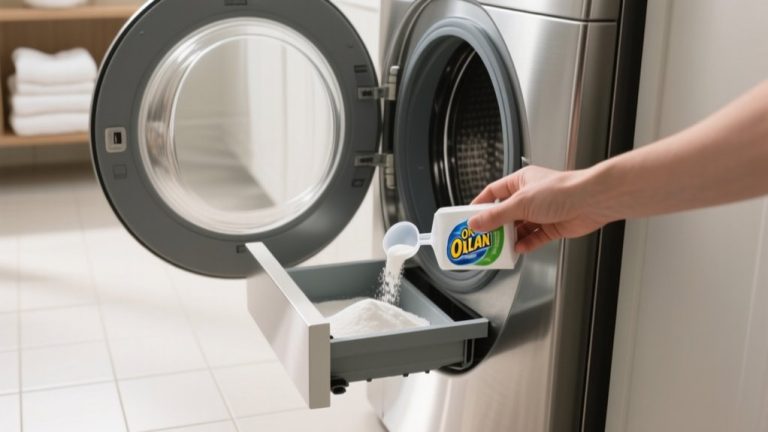
Use 1 scoop of OxiClean Powder, about 1/2 cup, per standard laundry load. For heavily soiled items, use 1.5 scoops.
Adjust the amount based on load size, soil level, and water hardness.
Conclusion
Now that you know what’s inside OxiClean powder, you see how its ingredients work like a microscopic army against stains. Sodium percarbonate and sodium carbonate form the powerhouse duo, breaking down grime efficiently, while surfactants and polymers boost removal and protect fabrics.
Fragrances add a subtle scent without overpowering. Compared to other stain removers, OxiClean balances effectiveness with safety and environmental care. Truly, it’s the stain-fighting equivalent of a chemical symphony in action.