Does Vinegar In Laundry Kill Bed Bugs – Straight Answer
You can’t rely on vinegar in laundry to kill bed bugs or their eggs because its acidity neither penetrates their protective exoskeletons nor leaves any lasting effect after evaporation. Vinegar may kill some visible adults on contact but fails against hidden life stages.
To fully eliminate bed bugs, you need heat treatments with temperatures above 60°C combined with thorough drying. Relying solely on vinegar risks infestation persistence and escalation. Understanding effective options helps you take the right action fast.
Key Takeaways
- Vinegar does not kill bed bugs or their eggs due to its inability to penetrate their protective exoskeletons.
- Vinegar may kill some adult bed bugs on contact but is ineffective for full infestations or eggs.
- Rapid evaporation of vinegar leaves no residual effect, making it useless against hidden bed bug life stages.
- Effective eradication requires washing clothes at 60°C (140°F) and high-heat tumble drying for 30-45 minutes.
- Relying on vinegar delays professional treatment, risking infestation growth and increased costs over time.
Does Vinegar in Laundry Kill Bed Bugs and Their Eggs?
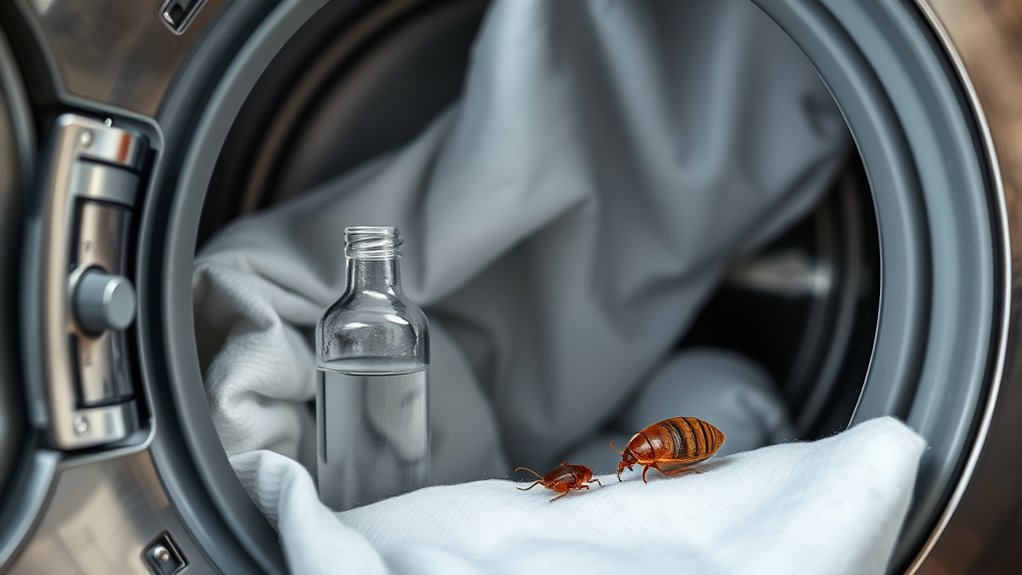
Although vinegar is commonly believed to have insecticidal properties, it doesn’t kill bed bugs or their eggs during laundry cycles because its acidity can’t penetrate their protective exoskeletons.
You might think vinegar kills bed bugs in laundry, but evidence shows it’s ineffective for a full infestation.
To effectively kill bed bugs and their eggs, you must wash infested items in hot water at a minimum of 60°C (140°F) and tumble dry on high heat for 30 to 45 minutes.
Relying on vinegar in laundry can delay professional treatment, reducing chances of effective elimination.
While DIY methods appeal, only heat-based processes reliably kill bed bugs and eggs.
Proper containment, such as sealing clothes in plastic bags before washing, further prevents spread during treatment.
Why Vinegar Alone Can’t Eliminate Bed Bugs
Because vinegar’s acidity can’t penetrate bed bugs’ protective exoskeletons or affect their eggs, using it alone won’t eliminate an infestation.
Vinegar may kill some visible adult bugs on contact, but it fails to kill bed bugs hiding in fabric folds or cracks, nor does it disrupt eggs.
Its rapid evaporation leaves no residual effect, allowing populations to rebound quickly.
When you rely solely on vinegar or other home remedies in laundry, you risk underestimating the infestation’s scope and delaying a thorough treatment plan.
Effective elimination requires proper laundering at high temperatures plus professional intervention to target all life stages.
To truly kill bed bugs and their eggs, you must integrate evidence-based methods beyond vinegar’s limited capacity.
How Hot Water and Dryer Heat Kill Bed Bugs
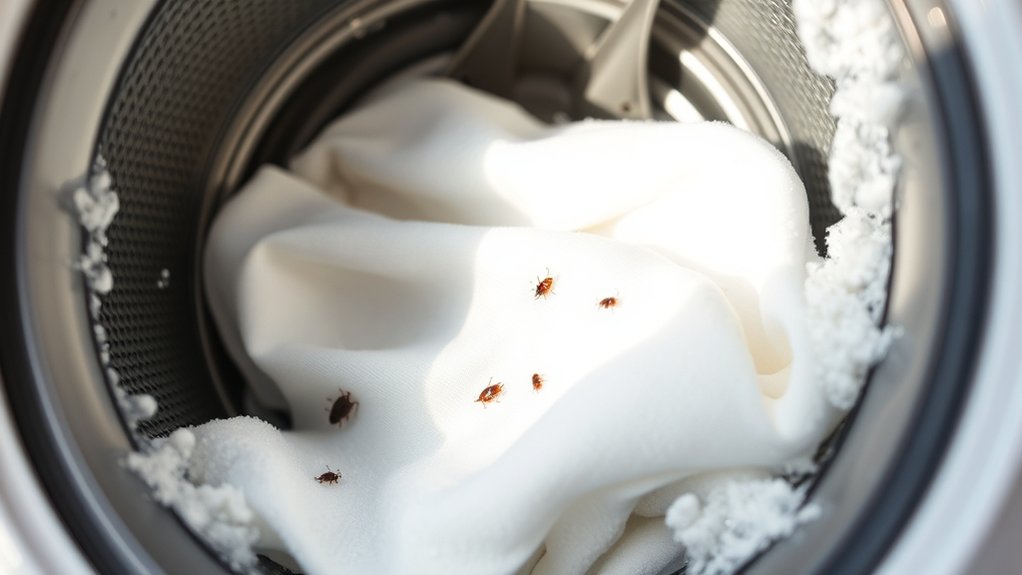
To effectively kill bed bugs and their eggs during laundering, you need to wash your clothes at a minimum of 60°C (140°F).
But that’s not all—after washing, it’s really important to tumble dry them on high heat for at least 30 minutes.
This helps the heat reach all the seams and makes sure every last bug is gone.
Heat Temperature Requirements
When treating bed bugs through laundry, maintaining a water temperature of at least 60°C (140°F) is critical to kill both the insects and their eggs effectively.
Hot water alone weakens these small bugs, but it’s not enough to eradicate an entire infestation.
The effective part of washing and drying lies in combining hot water with high heat during drying. Heat treatment raises the temperature beyond the bugs’ survival threshold, ensuring complete elimination.
Vinegar in laundry kill claims don’t replace the need for heat; instead, heat is essential to kill bed bugs.
Using lower temperatures or cool cycles won’t suffice.
To fully treat fabric infestations, you must rely on hot water followed by high heat drying to guarantee that bed bugs and their eggs are destroyed.
Dryer Cycle Importance
Although washing clothes in hot water weakens bed bugs and their eggs, the dryer cycle plays an essential role in ensuring complete eradication. Washing clothes at 60°C (140°F) is necessary but not always sufficient, as some adult bed bugs and eggs may survive.
Drying infested items on high heat for 30–45 minutes guarantees that residual bed bugs are killed by sustained heat exposure.
Vinegar, often suggested in laundry, doesn’t kill bed bugs because it can’t penetrate their exoskeleton or disrupt their biology.
To effectively kill bed bugs, rely on the combined thermal treatment from both washing and drying. Sealing infested items in plastic before laundry further prevents spreading.
Proper drying is critical; without high heat drying, bed bug eradication remains incomplete.
Professional Laundry and Heat Treatments for Bed Bugs
Harnessing professional laundry and heat treatments offers a scientifically validated method to eliminate bed bugs and their eggs effectively. You should wash infested items at 60°C (140°F) or higher to kill bed bugs and eggs reliably.
Following this, tumble drying on high heat for 30–45 minutes guarantees any survivors are destroyed by sustained high temperatures. Sealing infested clothes in plastic bags before washing prevents bed bugs from spreading during handling.
Moreover, professional heat treatment services raise ambient temperatures between 49°C and 60°C (120°F to 140°F), targeting all bed bug life stages without chemicals.
Combining these professional laundry and heat treatments provides a thorough, evidence-based approach to eradicate infestations safely and completely, confirming no bed bugs or eggs remain in your belongings.
Common Misconceptions About Using Vinegar for Bed Bugs
Why do many people believe vinegar can eliminate bed bugs despite scientific evidence to the contrary? The misconception comes from vinegar’s acidity, which is mistakenly assumed to disrupt bed bugs and their eggs. But vinegar’s chemistry doesn’t penetrate their exoskeletons, so it’s ineffective as a treatment.
When it comes to laundry, relying on vinegar overlooks the need for hot water and high heat to kill bed bugs effectively. Here’s a quick comparison:
| Claim | Fact | Recommendation |
|---|---|---|
| Vinegar kills bed bugs | Ineffective on bugs and eggs | Use hot water (≥60°C) |
| Vinegar in laundry | Unsupported by science | Employ professional pest control |
| Vinegar replaces heat | False, delays treatment | Prioritize heat-based methods |
Avoid misconceptions and trust evidence-based treatments to manage bed bugs effectively.
Risks of Relying on Vinegar in Laundry for Bed Bugs
If you rely on vinegar in your laundry to tackle bed bugs, you risk ineffective treatment and prolonged infestations.
Vinegar’s acidity doesn’t penetrate the bed bugs’ exoskeleton or kill their eggs, making it an ineffective pesticide.
Despite popular claims, no scientific evidence supports vinegar’s ability to eliminate bed bugs or their eggs through laundry treatment.
Using vinegar may give you a false sense of security, which can delay professional intervention essential for controlling infestations.
Proper treatment requires washing infested fabrics in water at 60°C or higher and drying at high heat for at least 30 minutes.
Relying solely on vinegar compromises bed bug eradication efforts and allows populations to grow.
This increases the severity of the infestation and the difficulty of eventual professional treatment.
Comparing Vinegar With Other DIY Bed Bug Treatments
While vinegar is commonly suggested for bed bug control, its limitations highlight the need to evaluate other DIY treatments.
Vinegar in laundry doesn’t kill bed bugs or their eggs effectively because its acidity can’t penetrate the exoskeleton.
Instead, heat treatment, like washing fabrics at 60°C (140°F) or higher, remains the most reliable DIY method to eliminate all life stages, including bed bug eggs. Steam cleaning also provides direct thermal control.
Heat treatment at 60°C or higher, including steam cleaning, effectively kills all bed bug life stages.
Essential oils and diatomaceous earth may repel or slowly reduce populations, but they lack the immediate efficacy of heat treatment.
Relying solely on vinegar risks incomplete bug control and infestation persistence.
For thorough eradication, integrating heat treatment with professional pest control services guarantees extensive management beyond what DIY options alone can achieve.
When It’s Time to Stop DIY Laundry and Call a Pest Control Expert
Even after multiple laundry cycles using DIY methods, persistent bed bug activity signals a need to escalate control measures by consulting a professional. Vinegar in laundry may kill bed bugs on contact but often misses hidden bugs and eggs in furniture or walls, allowing infestation to continue.
Professionals provide targeted treatment addressing all life stages, ensuring thorough elimination.
| Indicator | DIY Limitation | Professional Advantage |
|---|---|---|
| Persistent Bugs | Misses hidden life stages | Targets eggs, nymphs, adults |
| Recurring Infestation | Surface treatment only | Whole-home heat and chemical |
| Treatment Effectiveness | Vinegar kills some bugs only | Proven eradication strategies |
Don’t delay. Calling a professional prevents escalation and higher costs.
Frequently Asked Questions
Can Vinegar Damage My Clothes During Laundry?
Yes, vinegar can damage your clothes during laundry if you’re not careful. High concentrations or frequent use may weaken fabric fibers, especially in delicate materials, causing fading or discoloration.
To avoid damage, test vinegar on a small, inconspicuous area first and dilute it appropriately.
Also, check your garment’s care label since acidic solutions like vinegar can be harsh on sensitive fabrics.
Using vinegar sparingly helps protect your clothes while benefiting your laundry.
Is Vinegar Safe to Use Around Pets and Children?
You can safely use vinegar around pets and children since it’s non-toxic compared to many chemical cleaners.
Studies show that vinegar’s acetic acid concentration, typically 5%, causes only mild irritation on skin or eyes upon direct contact.
However, make sure there’s proper ventilation to reduce odor exposure. Always store it out of reach to prevent accidental ingestion, which might cause gastrointestinal upset.
Use vinegar cautiously but don’t rely on it solely for pest control.
How Often Should I Wash Clothes to Prevent Bed Bugs?
You should wash your clothes and bedding at least once a month to prevent bed bugs.
Increase the frequency after travel or stays in shared accommodations.
Use water temperatures of 60°C or higher and follow with a high-heat tumble dry cycle for 30–45 minutes. This effectively kills bed bugs and eggs.
Regular washing combined with proper storage in airtight containers minimizes infestation risks.
It also helps maintain a bed bug-free environment.
Does Vinegar Help With Bed Bug Bites or Itching?
Vinegar can provide mild, temporary relief for bed bug bite itching due to its acetic acid content, which soothes the skin slightly.
However, it doesn’t effectively reduce inflammation or heal the bites.
You should avoid applying vinegar directly if you have sensitive skin, as it may cause irritation.
For persistent itching or allergic reactions, rely on clinically proven treatments like antihistamines or hydrocortisone and consult a healthcare professional.
Can Vinegar Be Combined With Other Cleaning Agents Safely?
Imagine you mix vinegar with bleach to clean your kitchen; you’d create dangerous chlorine gas, risking respiratory harm. So, you shouldn’t combine vinegar with bleach.
Instead, you can safely mix vinegar with essential oils to boost its repellent properties, though this won’t effectively kill bed bugs.
Always perform patch tests and read labels carefully to avoid harmful reactions and maintain cleaning efficacy when combining vinegar with other agents.
Conclusion
While vinegar has some antimicrobial properties, it doesn’t reliably kill bed bugs or their eggs in laundry. Studies show that bed bugs can survive exposure to acetic acid concentrations found in household vinegar.
Instead, using water heated above 120°F and a high-heat dryer cycle effectively exterminates these pests. Relying on vinegar alone risks infestation persistence.
For proven results, combine heat treatments with professional pest control, as bed bugs can survive for months without feeding if not properly eliminated.