How Much Does A Load Of Laundry Cost In Electricity – Guide
You’ll spend about $0.49 in electricity per laundry load, with costs varying based on your washer type, water temperature, and dryer use. Cold water cycles use 0.3 to 1.0 kWh, while hot cycles can reach up to 4 kWh because of heating.
Dryers consume roughly 3.0 kWh per load, often the biggest electricity user. Choosing high-efficiency washers and sensor dryers can cut costs considerably. Understanding these factors can help you optimize your laundry energy use effectively.
Key Takeaways
- A single laundry load costs about $0.49 in electricity, with dryers consuming the most energy at around 3.0 kWh per load.
- Cold water cycles use 0.3 to 1.0 kWh, while hot water cycles consume 2.5 to 4.0 kWh due to water heating.
- High-efficiency washers use 25% less electricity, costing 0.3 to 0.7 kWh per load, saving up to $60 annually.
- Larger loads improve energy efficiency, and frequent small loads increase overall electricity consumption and costs.
- Using cold water, sensor dryers, and competitive electricity rates can save $50 to $100 annually on laundry energy bills.
Breakdown of Electricity Costs Per Laundry Load
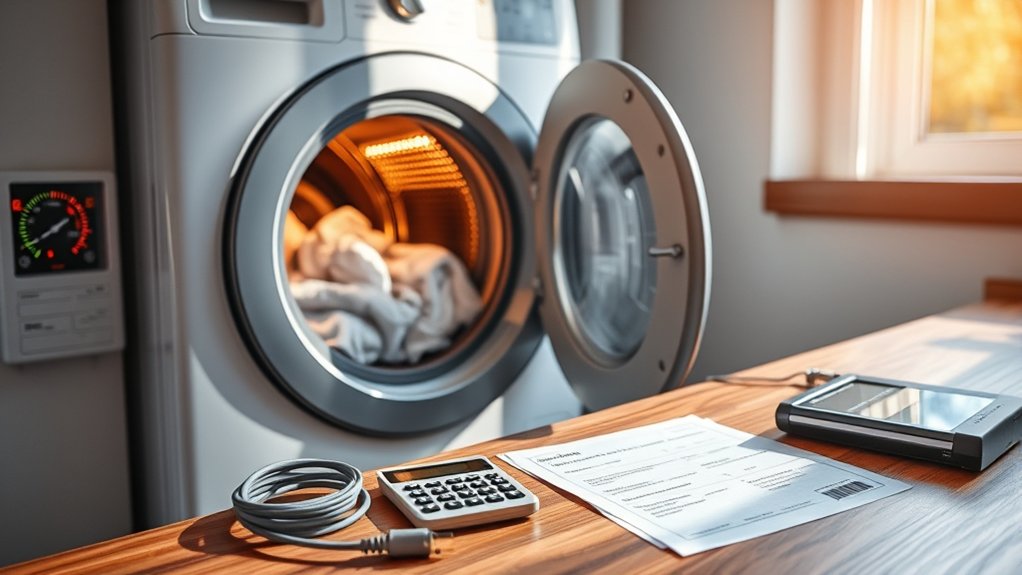
A single load of laundry typically costs about $0.49 in electricity, combining both washing and drying cycles.
Your washing machine’s electricity use varies considerably based on water temperature. Cold water cycles consume roughly 0.3 to 1.0 kWh, whereas hot water cycles spike to 2.5 to 4.0 kWh, substantially increasing your cost.
The dryer is the largest electricity consumer in the laundry process, using about 3.0 kWh per load.
With an average electricity rate of $0.15 per kWh, these figures translate directly into your utility expenses.
Opting for cold water washes enhances energy efficiency, potentially saving you $50 to $100 annually by reducing heating costs.
Understanding this breakdown helps you control your laundry electricity cost effectively.
How Washer Types Affect Laundry Electricity Cost
You’ll notice that the type of washer you use makes a big difference in how much energy your laundry consumes. For example, standard agitator models typically use between 0.5 and 1.0 kWh per cold load.
On the other hand, high-efficiency washers are more energy-friendly, using only about 0.3 to 0.7 kWh.
This difference comes down to how the washers operate. Agitators move clothes around with a central post, which tends to draw more power.
High-efficiency washers, however, often use impellers that spin gently to clean clothes, cutting down on electricity use without compromising on cleaning quality.
So, by choosing the right type of washer, you can reduce your energy consumption and potentially save between $35 and $60 every year.
It’s a smart way to keep your laundry costs—and your electricity bill—a bit lower.
Washer Energy Consumption
Three key types of washers, standard agitator, high-efficiency impeller, and front-loading machines, differ markedly in energy consumption, affecting your laundry electricity costs.
Standard washers use about 0.5-1.0 kWh per cold load, while high-efficiency impeller models only consume 0.3-0.5 kWh.
Front-loading washers, often ENERGY STAR certified, operate at 300-500W and also use 0.3-0.5 kWh per full load, making them more energy-efficient than older top-loaders.
ENERGY STAR washers reduce energy use by 25% and water by 33%, lowering your average cost per load.
Hot water cycles drastically increase energy per load. Front-loaders consume 2.5-3.5 kWh with hot water, compared to cold washes at 0.3-0.5 kWh.
Choosing an efficient washing machine greatly cuts your annual electricity costs, saving $35-$60 yearly versus less efficient models.
Efficiency Of Agitators
Understanding how different washer types impact your electricity use can help you make smarter choices about laundry appliances.
Standard washing machines with agitators consume 0.5-1.0 kWh per cold water load, considerably more than ENERGY STAR front-loaders, which use only 0.3-0.5 kWh.
High-efficiency top-loaders with impeller designs reduce electricity consumption by 25-45% compared to traditional agitators.
Agitator motors draw 500-1,000W, whereas front-loaders operate between 300-500W, demonstrating superior efficiency.
While agitators handle heavily soiled loads well, they may increase clothing wear, raising replacement costs.
Switching from an old agitator model to an ENERGY STAR front-loader can save you $35-$60 annually on energy and water bills.
Prioritizing efficient washing machines reduces electricity costs per load and supports long-term energy savings.
Why Water Temperature Makes a Big Difference
You use up to 4 kWh in a hot wash compared to just 0.5 kWh in a cold one. That’s mostly because heating the water takes up about 90% of the energy.
So, when you stick to lower temperatures, you cut down the biggest energy drain. Over time, this can add up to saving $50 to $100 on your energy bills each year.
It’s a simple way to save money and use energy more wisely.
Energy Use Comparison
Because heating water accounts for roughly 90% of the energy used in hot laundry cycles, choosing cold water can drastically reduce electricity consumption. Washing clothes in cold uses only 0.3-1.0 kWh per load for top-loaders and 0.3-0.5 kWh per load for front-loaders, compared to 2.5-4.0 kWh per load for hot cycles. This translates to a significant drop in the electricity cost per load and overall cost of doing laundry.
Here’s a clear energy use comparison:
| Wash Type | kWh per Load | Approx. Cost per Load ($) |
|---|---|---|
| Hot (Top-Loader) | 2.5 – 4.0 | 0.30 – 0.48 |
| Cold (Top-Loader) | 0.3 – 1.0 | 0.04 – 0.12 |
| Hot (Front-Loader) | 2.5 – 4.0 | 0.30 – 0.48 |
| Cold (Front-Loader) | 0.3 – 0.5 | 0.04 – 0.06 |
Switching to cold saves you $50-$100 yearly on average washing energy costs.
Heating Water Impact
While many factors influence laundry energy use, water temperature stands out as the primary driver of electricity consumption.
Heating the water accounts for roughly 90% of the energy used during a hot wash cycle, which consumes 2.5 to 3.5 kWh per load.
In contrast, a cold wash uses only 0.3 to 0.5 kWh, dramatically reducing energy consumption. This difference stems from the water heater’s power draw of 4,000 to 5,500 watts, which far exceeds the washer motor’s 300 to 1,000 watts.
By choosing cold wash cycles, especially with ENERGY STAR certified machines, you can cut energy use by 25% to 45%.
This reduction directly lowers energy bills, showing why water temperature plays a critical role in laundry’s overall electricity cost.
Cost Savings Potential
The difference in energy consumption between hot and cold water washes translates directly into cost savings for your household.
Washing in cold water uses just 0.3-0.5 kWh per load versus 2.5-3.5 kWh for hot washes, cutting electricity usage considerably.
Here’s how this impacts your cost savings potential:
- Switching to cold water can reduce energy costs by $50-$100 annually.
- About 90% of energy in hot washes heats water; cold washes avoid this.
- ENERGY STAR certified washers use 25% less energy and 33% less water, enhancing savings.
- Reducing hot wash frequency also lowers overall replacement costs by extending fabric life.
How Load Size and Frequency Impact Energy Costs
How does the size and frequency of your laundry loads affect your electricity bill? Load size plays a critical role in energy costs.
Larger loads are more energy-efficient per item because they maximize the energy and water used in each cycle, reducing electricity rates per wash.
Conversely, underloading wastes energy since machines consume similar electricity regardless of load size.
Washing frequency compounds this effect; frequent small loads increase overall consumption, raising your annual cost.
For example, a household running seven loads weekly uses about 676 kWh yearly, costing roughly $88 in electricity.
To optimize energy costs, balance washing frequency with larger, energy-efficient loads.
This approach minimizes wasted energy and lowers your electricity bill by reducing the number of cycles needed without compromising cleanliness.
Why Shorter Cycles Save Electricity
You can cut electricity use considerably by choosing shorter washing cycles.
These cycles reduce the runtime of power-hungry components like motors and heaters.
For example, quick wash settings can slash cycle time by up to 50%, which directly lowers energy consumption from 0.5 to 1.0 kWh per load.
By optimizing the cycle length, you not only save energy but also reduce your annual laundry electricity costs by up to $100.
It’s a simple change that makes a big difference!
Reduced Energy Consumption
Because shorter washing cycles consume considerably fewer kilowatt-hours, you can cut electricity use by 20-30% per load compared to longer settings. This reduced energy consumption directly lowers your electricity costs and overall cost to run each load.
Energy-efficient washers, especially front-loaders, optimize washing performance in shorter cycles, enhancing savings.
To improve your laundry habits and minimize energy use, consider these points:
- Typical cycles use 0.3 to 1.0 kWh; shorter cycles reduce this by up to 30%.
- Using short cycles for lightly soiled clothes saves $20-$30 annually on electricity.
- Each minute saved in cycle time decreases cumulative energy consumption.
- Proper load management maximizes efficiency and cost-effectiveness per load.
Adopting these strategies guarantees you lower both energy use and electricity expenses effectively.
Faster Cycle Benefits
Shorter wash cycles cut electricity use by reducing the motor’s operating time, lowering energy consumption measured in kilowatt-hours (kWh).
By choosing faster cycles, you can reduce energy consumption by up to 30% compared to longer cycles. This directly translates to lower electricity costs per load.
Energy-efficient washers use sensor technology to adjust cycle duration based on load size, ensuring no excess electricity is wasted.
Quick wash settings are especially effective for lightly soiled clothes, delivering efficient cleaning while consuming less electricity.
Incorporating these faster cycles into your routine not only optimizes energy use but can also save you an estimated $20-$40 annually on electricity costs.
Dryers’ Impact on Laundry Electricity Costs
Dryers exert a substantial influence on your laundry electricity costs, consuming around 3.0 kWh per load, which is six times more than washing machines that typically use about 0.5 kWh per load. This significant energy use drives up the actual cost reflected on your electricity bill.
Dryers use about 3.0 kWh per load, significantly increasing your laundry electricity costs compared to washing machines.
Consider these points:
- Average energy consumption per load for dryers is 3.0 kWh, substantially increasing expenses associated with laundry.
- Operating a dryer annually can add about $88 to your electricity bill, depending on rates and usage.
- Sensor technology in modern dryers reduces energy waste by stopping cycles once clothes are dry, optimizing energy use.
- Drying full loads maintains the same energy consumption per load, enhancing cost-efficiency compared to smaller loads.
Understanding dryers’ impact helps manage your laundry energy and water per cycle expenses effectively.
Calculate Your Laundry Electricity Cost
Calculating the electricity cost of your laundry starts with understanding energy consumption per load: washers typically use about 0.5 kWh, while dryers consume around 3.0 kWh, costing roughly $0.49 per combined load at an average rate of $0.15 per kWh.
Your washing machine’s use of cold water can reduce energy consumption to 0.3-0.5 kWh per load, considerably lowering electricity costs.
Doing seven loads weekly results in an annual electricity cost near $88.
Opting for larger loads improves energy efficiency by maximizing energy use per item, reducing overall consumption.
Choosing energy-efficient practices and appliances helps control your laundry electricity costs.
How ENERGY STAR Washers Cut Laundry Costs
While upgrading to an ENERGY STAR washer requires an initial investment, it cuts your laundry electricity costs considerably by using about 25% less energy and 33% less water than standard washers.
Here’s how ENERGY STAR washers reduce your costs effectively:
- They consume only 0.3-0.5 kWh per cold wash load, costing you approximately $1.40-$2.75 monthly on electricity.
- Their front-loader design uses 25-45% less electricity than traditional agitator top-loaders.
- You save $35-$60 annually on your energy bill compared to older, non-efficient washers.
- Reduced water use lowers overall utility expenses and environmental impact.
Choosing an ENERGY STAR washing machine optimizes your energy and water use per load of laundry, directly minimizing your electricity and water costs.
How to Lower Your Laundry Electricity Costs
If you want to cut down on your laundry electricity costs, focusing on how you wash and dry your clothes can make a measurable difference. Start by using cold water. Since 90% of energy in hot washes heats water, switching to cold saves $50-$100 annually.
Next, choose high-efficiency washers. They use 25% less electricity and 33% less water per load compared to standard models. Always maximize load size to improve energy efficiency. Running smaller loads wastes electricity and water.
Furthermore, consider sensor dryers that stop when clothes are dry, avoiding excess electricity use.
Finally, shop around for competitive electricity rates in your area to reduce costs further. By applying these strategies, you’ll effectively use less electricity per load and lower your overall laundry expenses.
Monthly vs Annual Laundry Electricity Costs
Although the cost per load of laundry averages around $0.49, understanding how these expenses add up monthly and annually helps you manage your budget better. The costs vary greatly depending on your washer’s efficiency and wash temperature.
A typical household doing seven loads weekly faces about $3.67 monthly and $88 annually in laundry electricity costs.
A household washing seven loads weekly spends approximately $3.67 monthly and $88 annually on laundry electricity.
Switching to an energy-efficient washer can cut monthly costs to $1.40-$2.75 with cold washes.
This translates to annual savings between $30 and $80 compared to older models.
Washing mostly in cold water with a front-loader, consuming 0.3-0.5 kWh per load, maximizes energy savings annually.
Frequently Asked Questions
Can Laundry Detergent Brand Affect Electricity Consumption?
Yes, the laundry detergent brand can affect electricity consumption indirectly.
If you use a high-efficiency detergent designed for cold water, you’ll likely reduce energy use by avoiding hot washes, which consume 2.5-3.5 kWh versus 0.3-0.5 kWh for cold cycles.
Poor detergents may force you to run longer or extra cycles, increasing electricity.
Choosing concentrated, eco-friendly detergents helps optimize wash performance and minimizes energy waste.
Does the Type of Fabric Influence Energy Use During Washing?
Yes, the type of fabric directly influences energy use during washing.
For example, cotton loads often consume between 0.5 to 1.0 kWh due to higher temperature and longer cycles, while synthetics typically use 0.3 to 0.5 kWh with cold washes.
If you wash heavily soiled fabrics like jeans or towels, expect longer cycles, increasing energy use.
Choosing gentle cycles for delicates not only saves energy but also protects your clothes.
How Does Machine Maintenance Impact Electricity Efficiency?
You’ll save up to 15% on electricity by regularly maintaining your washing machine.
Cleaning filters and hoses guarantees efficient operation and prevents excessive power use from drainage or agitation issues.
Neglecting maintenance can hike your energy costs by 10-20%, as worn parts draw more power, sometimes over 1 kWh extra per load.
Annual checks catch problems early, keeping your machine energy-efficient and extending its lifespan considerably.
Are Smart Washers More Energy-Efficient Than Regular Ones?
Imagine your laundry spinning faster, using less water and energy with every cycle. Yes, smart washers are more energy-efficient than regular ones.
They cut energy use by about 25% and water by 33%, thanks to load sensing and optimized cycles. Their shorter wash times and data-driven adjustments reduce waste, saving you money and resources.
Does Using Cold Water Rinse Save Electricity?
Yes, using a cold water rinse saves electricity considerably.
Heating water consumes about 90% of energy in hot wash cycles, while cold rinses use only 0.3-0.5 kWh per load, compared to 2.5-3.5 kWh for hot washes.
By switching to cold water, you can reduce your energy usage by up to 85%, potentially saving $50 to $100 annually.
Plus, cold rinsing preserves fabric quality, extending clothing lifespan.
Conclusion
You might be surprised to learn that using cold water instead of hot can cut your laundry’s electricity cost by up to 90%. By choosing an ENERGY STAR washer and opting for shorter cycles, you can save even more.
Understanding how load size and frequency impact energy use helps you make smarter choices, lowering your monthly and annual bills. With these small changes, you’ll see a measurable difference in both energy consumption and costs.