How Much Bleach To Add To Laundry – Here’s the Math
To add bleach to laundry accurately, use ⅓ cup for lightly soiled and ⅔ cup for heavily soiled loads in standard washers. Never exceed the max fill line in high-efficiency washers.
For sanitizing, ½ cup works for standard models, while HE washers need ¼ cup. Always measure precisely, avoid mixing bleach with detergent, and check fabric care labels to prevent damage.
Managing water quality helps maintain fabric color. Understanding these details guarantees effective cleaning at the right dose. More insights cover measuring, water effects, and bleach application techniques.
Key Takeaways
- Use ⅓ cup bleach for lightly soiled loads and ⅔ cup for heavily soiled loads in standard washers.
- For sanitizing, add ½ cup bleach in standard washers and ¼ cup in high-efficiency washers without exceeding max fill lines.
- Always measure bleach with a liquid measuring cup and avoid mixing bleach with detergent before washing.
- Dilute ¼ cup bleach in ¾ cup water for pretreating stains and always rinse fabrics thoroughly after bleaching.
- Adjust bleach amounts based on fabric type and water quality, limiting soaking to five minutes to prevent yellowing.
How Much Bleach Should You Use for Different Laundry Loads?
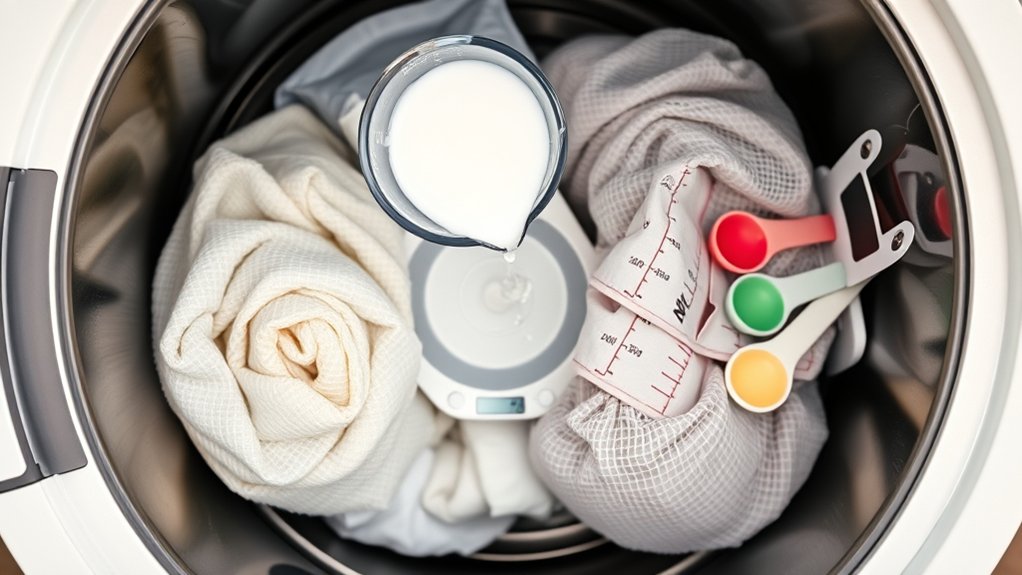
How much bleach should you use for different laundry loads? The answer depends on soil level and washer type.
For standard washers, lightly soiled loads require ⅓ cup of bleach, while heavily soiled ones need ⅔ cup. For sanitizing, ½ cup is appropriate.
High-efficiency washers demand more precision: use only ¼ cup for sanitizing, and never exceed the max fill line for lightly or heavily soiled loads.
Always check the bleach packaging for exact measurements, as formulas vary.
To maximize effectiveness, add bleach to the designated compartment or at the recommended wash cycle stage.
Understanding how much bleach you should use guarantees you sanitize without damaging fabrics or machines.
This methodical approach balances cleanliness with safety, optimizing your laundry results every time.
What’s the Right Bleach Amount for Standard vs. High-Efficiency Washers?
Understanding the correct bleach amount hinges on recognizing the differences between standard and high-efficiency washers. For standard washers, use ½ cup of bleach product for sanitizing and ⅓ cup for lightly soiled loads. Heavily soiled laundry permits up to ⅔ cup.
Proper bleach use varies: standard washers need more bleach, from ⅓ to ⅔ cup depending on soil level.
In contrast, high-efficiency washers require less bleach. Typically, you shouldn’t exceed the dispenser’s maximum fill line, around ¼ cup for sanitizing.
Always add the bleach product according to your washer’s instructions, either into the dispenser or when the tub is half-filled for standard models.
Never mix bleach with detergent before washing. By following these precise guidelines, you guarantee effective sanitization without damaging fabrics or the washer.
This way, you optimize your bleach product’s performance for each machine type.
Adjusting Bleach Amounts for Soil Level and Fabric Type
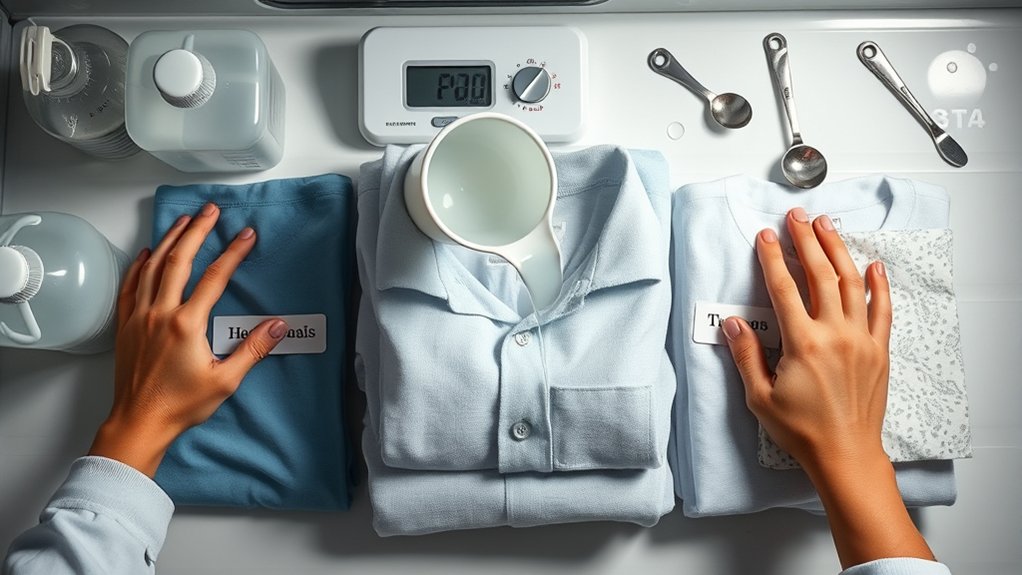
Although bleach is a powerful cleaning agent, you need to adjust its amount based on the soil level and fabric type to avoid damage. For lightly soiled laundry, use about ⅓ cup of bleach solution per standard load to maintain brightness without overexposure.
Heavily soiled items require increasing the bleach solution to ⅔ cup, but never exceed your washer’s max fill line, especially in high-efficiency models.
When washing whites, chlorine bleach is effective, while color-safe, non-chlorine bleach protects colored fabrics from discoloration.
Always check garment care labels, as fabrics like wool, silk, and spandex are incompatible with bleach and risk damage.
Adjusting the bleach solution methodically guarantees ideal cleaning without compromising fabric integrity or color vibrancy.
How to Measure Bleach Accurately for Every Load
Adjusting bleach amounts for soil level and fabric type sets the foundation for accurate measurement in each load.
To measure how much bleach you need, start by identifying your washer type.
For standard washers, use ½ cup for sanitizing, ⅓ cup for lightly soiled loads, and ⅔ cup for heavy soil. High-efficiency washers require ¼ cup for sanitizing and the max fill line for both light and heavy soils.
Always refer to product packaging for exact measurements, as formulations vary.
When pretreating, dilute ¼ cup bleach in ¾ cup water to avoid fabric damage.
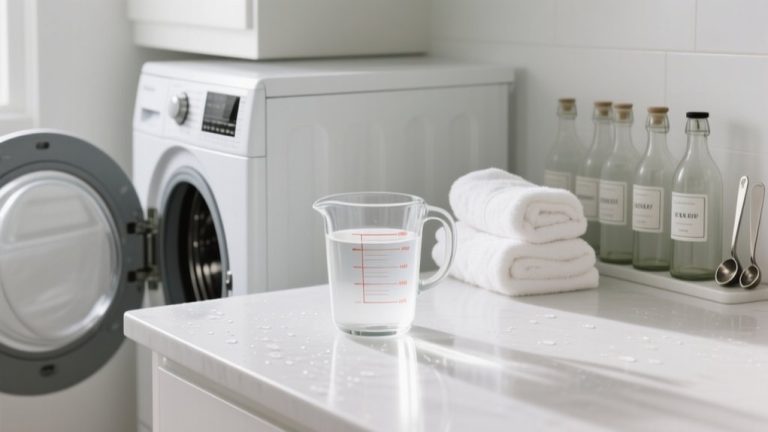
Use measuring cups designed for liquids to guarantee precision.
Following these exact steps assures you measure how much bleach effectively, protecting fabrics and maintaining cleaning power without overuse or waste.
What Happens When You Use Too Much or Too Little Bleach?
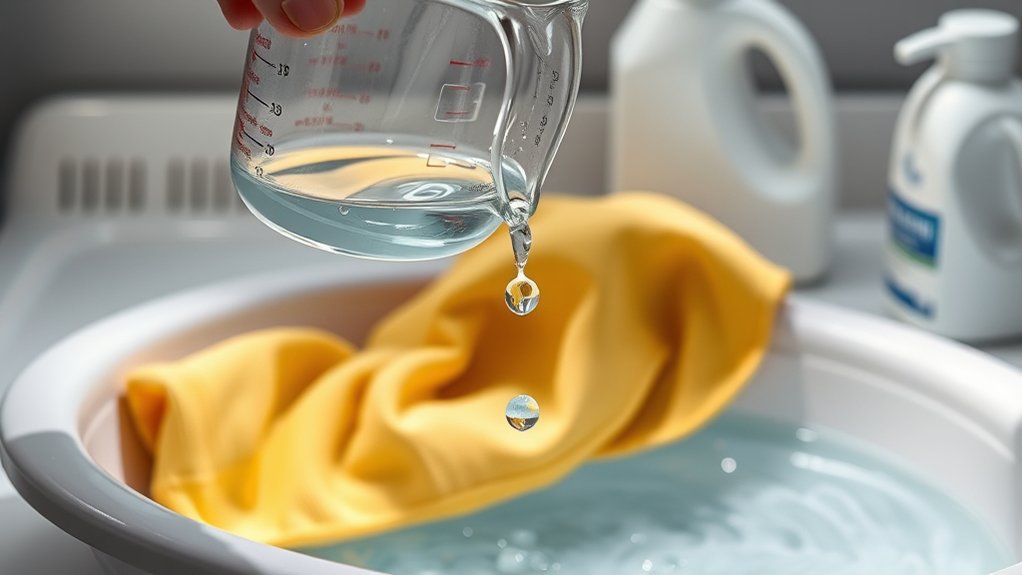
When you use too much bleach, you risk yellowing your fabrics, especially if the concentration exceeds the recommended ¼ cup per gallon of water. This effect intensifies with prolonged soaking, such as overnight, which can cause irreversible discoloration and weaken fabric fibers.
Conversely, using too little bleach compromises disinfection, allowing germs to survive, particularly on visibly soiled items.
To balance effectiveness and fabric care, adhere strictly to dilution guidelines and limit soaking time.
Remember, both excessive and insufficient bleach use undermine laundry quality. Too much bleach damages fabric integrity, while too little fails sanitation.
How Water Quality Affects Bleach Effectiveness and Fabric Color
You should think about how metals in hard water—like iron and manganese—react with bleach and can make your fabrics turn yellow. It’s a common issue that many don’t realize.
And here’s the thing: using more bleach than recommended doesn’t help. In fact, it can make the yellowing even worse.
So, it’s really important to stick to the amounts suggested on the label. If you’re unsure about your water quality, testing it can be a smart move.
Plus, using water treatment systems to reduce those metal levels can make a big difference. Not only will bleach work better, but your fabrics will keep their color longer, too.
Metals Impact On Bleach
Although bleach is a powerful laundry agent, its effectiveness can diminish if your water contains metals like iron and manganese. These metals react with bleach, causing yellowing of fabrics during washing. Understanding the metals’ impact on bleach is essential for ideal laundry results.
Clorox™ Disinfecting Bleach includes a polymer that helps mitigate these reactions, but high metal concentrations may still cause discoloration. To manage this, test your water regularly to determine metal levels.
If you find elevated metal content, consider installing a water treatment system to reduce these metals effectively.
Hard Water Challenges
Metals like iron and manganese commonly found in hard water create challenges for bleach’s cleaning power and fabric care. These metals react with bleach, often causing yellowing of fabrics.
While Clorox™ Disinfecting Bleach contains a polymer to reduce this reaction, using too much bleach per gallon can still lead to discoloration. To manage this, test your water quality regularly to gauge metal concentration.
Adjust your bleach per gallon accordingly, ensuring you don’t exceed recommended dilution to minimize yellowing. Understanding your water’s hardness allows you to fine-tune bleach use for ideal cleaning without damaging fabrics.
Water Treatment Benefits
When water contains high levels of iron and manganese, these metals can interfere with bleach’s cleaning action and cause fabric yellowing during laundry. You can mitigate this by considering water treatment options that reduce metal concentrations.
Installing a water treatment system effectively lowers iron and manganese levels, enhancing bleach’s efficacy while preserving fabric color. Although Clorox™ Disinfecting Bleach includes a polymer to combat metal reactions, it may not fully prevent discoloration if hard water persists.
Regularly testing your water quality allows you to identify problematic metal concentrations and adjust your bleach use accordingly.
By combining proper bleach dilution with water treatment, you optimize cleaning performance and minimize yellowing risks, especially in hard water areas.
Water treatment is a critical step toward consistent, high-quality laundry outcomes.
Best Ways to Add Bleach in Washers With and Without Dispensers
Two key methods exist for adding bleach to your laundry depending on whether your washer has a bleach dispenser.
If your machine includes a bleach dispenser, pour up to ¼ cup of Clorox™ Disinfecting Bleach directly into it, making sure you don’t exceed the fill line. The dispenser automatically adds bleach at the proper time, usually before the wash cycle starts.
For washers without a bleach dispenser, fill the drum halfway with water to dilute the bleach and prevent fabric damage.
Then carefully add bleach: use ⅓ cup for lightly soiled loads and up to ⅔ cup for heavily soiled ones.
Always check your washer’s owner’s manual for model-specific bleach guidelines to get the best cleaning while protecting your fabrics and machine.
How Regular, Proper Bleach Use Keeps Clothes Bright and Clean
You’ll keep your whites bright by adding the right amount of bleach—about ¼ cup per gallon of water. This helps avoid yellowing, which can happen if you use too much.
Just make sure you don’t soak your clothes for longer than five minutes, because that can damage the fabric.
And don’t forget to rinse everything thoroughly afterward to get rid of any bleach residue and keep your clothes feeling fresh and clean.
Correct Bleach Dilution
How much bleach should you add to guarantee your laundry stays bright without damaging fabrics? The key lies in correct bleach dilution.
Use ¼ cup of Clorox™ Disinfecting Bleach per gallon of water to achieve an effective, safe solution for brightening.
For washing cycles, add ⅓ cup directly to the wash to maximize disinfecting power without overexposure.
Avoid soaking fabrics in bleach for more than five minutes to prevent damage and discoloration.
Regularly applying these precise ratios helps maintain fabric integrity and reduces yellowing caused by reactions with hard water metals.
Always verify thorough rinsing or a complete machine wash after bleaching to remove residual chemicals.
Following these exact measures guarantees your clothes stay bright while protecting fabric quality.
Preventing Fabric Yellowing
Although bleach effectively brightens fabrics, using it regularly with the correct dilution prevents yellowing caused by excessive concentration or prolonged soaking.
Stick to the recommended ratio of ¼ cup bleach per gallon of water to avoid fabric damage.
Limit soaking time to five minutes maximum, as extended exposure, especially overnight, can trigger yellowing.
Be mindful of hard water, which contains metals like iron that react with bleach and accelerate discoloration.
To counteract yellowing from improper bleach use, consider adding Clorox 2™ for Colors Laundry & Fabric Stain Remover as a brightening agent.
Always separate whites from colors to prevent color transfer, which can contribute to fabric dullness.
Tips to Prevent Yellowing and Fabric Damage From Bleach
When using bleach in your laundry, controlling the concentration and exposure time is essential to prevent yellowing and fabric damage.
Use Clorox™ Disinfecting Bleach at a precise ratio of ¼ cup per gallon of water to avoid excessive bleach concentration.
Dilute Clorox™ Disinfecting Bleach at ¼ cup per gallon to ensure safe, effective cleaning without fabric damage.
Limit soaking time to no more than 5 minutes, as prolonged exposure increases discoloration risk.
If you have hard water with metals like iron, treat it beforehand because these minerals react with bleach, accelerating yellowing.
Regularly applying the correct amount of bleach maintains fabric integrity.
To counteract any yellowing resulting from improper bleach use, consider Clorox 2™ for Colors Laundry & Fabric Stain Remover as a brightening alternative.
Frequently Asked Questions
Can Bleach Be Mixed With Other Laundry Detergents Safely?
Yes, you can mix bleach with laundry detergents safely, but you need to add bleach after the detergent. This prevents bleach from neutralizing the detergent’s cleaning power.
Always pour bleach into the designated dispenser or when the drum is half full of water.
Avoid mixing bleach directly with fabric softeners, as this creates harmful vapors.
Following these steps guarantees your laundry gets cleaned effectively and safely every time.
How Long Should Clothes Soak in Bleach Before Washing?
Don’t soak your clothes in bleach for an eternity. Keep it under 5 minutes to avoid fabric damage.
Use a precise ¼ cup of bleach per gallon of water for soaking.
After that, rinse thoroughly or run a wash cycle immediately. Prolonged exposure, especially overnight, can lead to yellowing and weaken fibers.
Follow these guidelines methodically to maintain your clothes’ integrity and color without risking irreversible harm.
Is Chlorine Bleach Safe for All White Fabrics?
Chlorine bleach is generally safe for most white fabrics like cotton and polyester, but you need to be cautious.
Always check your garment’s care label before using bleach.
Avoid soaking fabrics longer than 5 minutes because overexposure can cause yellowing or damage, especially in synthetic fibers.
Stick to recommended dilutions, like ¼ cup bleach per gallon of water, to sanitize effectively without harming your clothes.
Use bleach methodically and sparingly for best results.
Can Bleach Remove Mold and Mildew Stains Effectively?
Imagine spotting stubborn mold and mildew stains fading away like morning mist under sunlight. Yes, bleach can effectively remove those stains when you use it right.
Mix ¼ cup of Clorox™ bleach in a gallon of water, apply it on pre-cleaned surfaces, and let it sit for at least one minute. This method kills 99.9% of germs and lifts stains, but always wear gloves and guarantee good ventilation for safety.
What Are Eco-Friendly Alternatives to Traditional Bleach?
You can use hydrogen peroxide as a powerful, eco-friendly bleach alternative. Just apply a 3% solution directly to stains.
Baking soda brightens and neutralizes odors naturally, while vinegar softens fabrics and removes odors when added during the rinse cycle.
Oxygen-based bleaches like OxiClean release hydrogen peroxide safely for stain removal.
Lemon juice’s citric acid also gently whitens fabrics. These options minimize harsh chemicals while maintaining effective cleaning power.
Conclusion
You might think a splash of bleach is harmless, but too much can ruin your favorite clothes faster than you can blink. Using the exact amount, tailored to load size, washer type, and fabric, isn’t just smart; it’s essential.
Precision in measuring bleach keeps your laundry spotless without the risk of damage or yellowing. So, don’t guess—calculate. Your clothes will thank you with lasting brightness and cleanliness every single wash.