How Much Does It Cost To Lease Commercial Laundry Equipment
You can expect to pay between $200 and $400 per month to lease commercial laundry equipment, with costs depending on the lease term, equipment type, brand, and your business credit score.
Longer lease terms lower monthly payments but raise total costs, while washers usually cost more than dryers. Established businesses get better rates, but startups may face higher fees.
Leasing also offers tax advantages and flexibility. Understanding these factors will help you choose the best lease option for your needs.
Key Takeaways
- Monthly lease costs for commercial laundry equipment range from around $200 for stacked dryers to $205 for vended express washers.
- Longer lease terms (24-60 months) reduce monthly payments but increase total interest expenses.
- Established businesses with good credit secure lease rates between 7% and 9%, while startups often pay above 10%.
- Leasing multiple units or choosing trusted brands can lower overall monthly leasing expenses and reduce maintenance costs.
- Operating leases offer lower monthly payments and upgrade flexibility; capital leases have higher payments but grant ownership after term.
Lease Terms and Their Impact on Monthly Costs
When you lease commercial laundry equipment, the terms you agree to will directly shape your monthly costs and overall financial commitment. Lease terms usually range from 24 to 60 months. Longer terms lower your monthly costs but increase total expenses due to added interest.
Your creditworthiness also affects leasing agreements. Established businesses often secure better rates (7% to 9%), while startups may pay over 10%. Monthly costs vary by equipment type, with stacked dryers starting around $200/month.
Creditworthiness influences lease rates, with established businesses paying 7%-9% and startups often exceeding 10%.
Pay attention to the lease’s residual value and buyout options, as these influence monthly payments.
Moreover, leasing agreements that include upgrade options provide flexibility, allowing you to swap or upgrade equipment mid-term. This can improve operational efficiency and potentially reduce long-term expenses.
Understanding these factors helps you make informed leasing decisions.
Which Laundry Equipment Types Drive Leasing Expenses
You’ll find that the type of equipment you choose really impacts your leasing costs. For example, washers usually cost more to lease than dryers.
Also, the number of machines you lease plays a role. Leasing in bulk can actually help lower your monthly expenses.
On top of that, picking trusted brands and reliable models can reduce maintenance problems and keep your long-term costs down.
It’s all about making smart choices from the start.
Equipment Type Impact
Because commercial laundry equipment varies widely in type and capacity, the leasing costs you face can differ markedly. The equipment type directly impacts your leasing costs and monthly payments.
For instance, stacked dryers start around $200/month, while vended express washers hover near $205/month.
Larger capacity machines, like a 65-pound washer priced at about $15,000, naturally raise your lease payments due to their higher value.
Choosing energy-efficient machines, especially front-loading washers, can reduce operational expenses since they use 50% less water and energy than top-loaders.
Furthermore, specialized hard-mount machines designed for heavy use may increase leasing costs but offer greater durability and efficiency.
Understanding how each equipment type influences leasing costs helps you select the best value without compromising performance or budget.
Machine Quantity Influence
Leasing expenses rise sharply as you increase the number of machines in your commercial laundry setup. Leasing costs per machine typically range from $100 to $500 monthly, depending on type and features. However, when you lease in bulk, you can secure significant discounts that lower your average monthly fee per unit.
Understanding which machines drive your leasing expenses helps you budget smartly.
| Equipment Type | Monthly Fee per Machine | Notes |
|---|---|---|
| Stacked Dryers | $200 | Common, moderate cost |
| Vended Express Washers | $205 | Slightly higher leasing cost |
| High-Capacity Machines | $400+ | Specialized, increases costs |
Brand And Model Effects
While the number of machines impacts your overall leasing costs, the specific brand and model you choose play a major role in determining your monthly payments.
Leasing costs for commercial laundry equipment vary widely, influenced by several factors:
- Higher-capacity machines, like 65-pound washers, drive up monthly payments because of their enhanced functionality.
- Energy-efficient front-loading washers may cost more to lease but they cut utility expenses over time.
- Trusted brands such as Speed Queen, Dexter, and UniMac often come with higher lease rates, reflecting reliability and lower maintenance.
- The choice between hard-mount and soft-mount units affects costs. Hard-mount models are suited for heavy use and usually increase leasing expenses.
How Your Business Credit Score Affects Lease Rates
How exactly does your business credit score influence the lease rates you’re offered? Leasing companies closely evaluate your credit score to gauge risk, which directly affects the lease rates and monthly payments you’ll face.
Established businesses with a credit score above 600 typically secure lower lease rates, often between 7% and 9%. In contrast, startups with lower scores encounter rates above 10%, reflecting higher perceived risk.
A strong credit score not only lowers monthly payments but also reveals better lease terms, including potential purchase options at reduced rates.
Furthermore, leasing companies may require personal guarantees from startups, increasing costs and complicating approval.
Maintaining a solid credit score can also provide access to special promotions like 0% financing, ultimately reducing the total cost of leasing and improving your cash flow management.
Operating vs. Capital Leases: Which Is Best for Your Laundromat?
Your business credit score sets the stage for the lease rates you’ll encounter. But choosing between operating and capital leases will shape how you manage payments, ownership, and tax benefits over time. Here’s what to evaluate:
- Operating leases offer lower monthly payments and flexibility to upgrade. They’re ideal if you want to stay current with technology.
- Capital leases come with higher monthly payments but grant ownership after the lease term. They’re perfect for long-term use.
- Tax benefits differ. Operating leases let you deduct the full monthly payment, while capital leases allow deductions on interest only.
- Lease terms range from 24 to 60 months. Longer terms lower monthly payments but increase total cost through interest.
Choosing the right lease depends on your cash flow, upgrade plans, and tax strategy.
Understanding Residual Values and Buyout Options for Laundry Equipment
What role does residual value play in shaping your lease payments and end-of-term options? Residual value directly impacts your monthly payments. The higher it is, the lower your monthly costs.
But don’t overlook how it affects buyout options at lease end. You’ll commonly encounter Fair Market Value (FMV), $1 buyout, or a 10% purchase option. Each influences total expenses differently.
For example, a $1 buyout often offers significant tax benefits, letting you deduct the full equipment cost upfront. Understanding these dynamics helps you project overall costs accurately since lower monthly payments can mean higher buyout expenses.
Maintenance and Repair Coverage: What’s Included and What It Costs
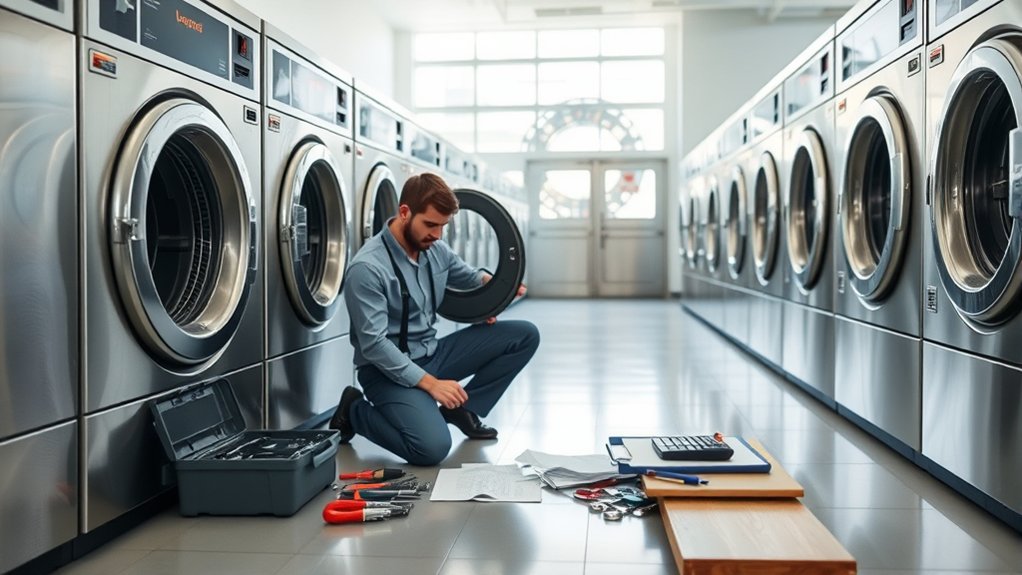
Although leasing commercial laundry equipment often lowers upfront costs, understanding maintenance and repair coverage is crucial to avoid unexpected expenses. When you lease, here’s what to take into account:
- Full-service leases usually include routine maintenance and repairs. This can reduce downtime and surprise costs.
- Some agreements require you to handle repairs yourself, so check what’s covered before signing.
- Opt for providers who bundle service and parts into monthly fees. This helps simplify budgeting and guarantee reliability.
- Extensive coverage typically costs more but saves you from unplanned financial burdens and operational disruptions.
How Leasing Laundry Equipment Protects You From Obsolescence
When you lease commercial laundry equipment, you get the flexibility to upgrade to the latest technology without those high upfront costs.
Plus, leasing means the risk of obsolescence is on the provider, not you. So, you won’t be stuck with outdated machines that slow down your efficiency.
This way, your operations stay competitive, and you’re always guaranteed access to energy-efficient, cutting-edge equipment.
It’s a smart move that keeps your business running smoothly without the hassle of constantly buying new machines.
Technology Upgrade Flexibility
Because technology in commercial laundry equipment evolves rapidly, leasing offers you a strategic advantage by allowing regular upgrades to the latest, most energy-efficient machines with advanced payment systems.
Leasing gives you the flexibility to stay ahead without the burden of outdated equipment.
Here’s how leasing technology upgrade flexibility benefits you:
- Upgrade Easily: Return old machines at lease end and switch to newer models with cutting-edge features.
- Fixed Costs: Lock in predictable monthly payments even when upgrading annually.
- Lower Upfront Investment: Preserve cash flow by avoiding large purchases while accessing top-tier technology.
- Stay Competitive: Maintain operational efficiency and appeal with energy-efficient, modern equipment.
With leasing, you embrace technology upgrades smoothly, ensuring your business stays efficient and future-ready without owning obsolete machines.
Transferring Obsolescence Risk
Leasing commercial laundry equipment lets you avoid the hidden costs and headaches of obsolete machines by transferring that risk to the leasing company. When you lease, the obsolescence risk no longer falls on you. The leasing company handles equipment maintenance and replacement, ensuring your machines stay current and efficient.
You benefit from fixed monthly payments, which simplify budgeting and eliminate surprises tied to aging equipment. At the end of your lease term, you can return outdated machines and upgrade without the hassle of selling old units. This setup keeps you competitive with access to the latest technology, minimizes downtime, and reduces utility costs through energy-efficient models.
Why Startups and Established Businesses Pay Different Leasing Rates
Although both startups and established businesses seek to lease commercial laundry equipment, you’ll find their leasing rates differ markedly due to creditworthiness and risk assessment. Understanding these differences helps you negotiate better terms.
- Established businesses usually enjoy leasing rates between 7% and 9%, while startups often face rates over 10% because of higher perceived risk.
- A credit score of 600+ typically qualifies an established business for favorable terms. Startups generally need at least 640.
- Monthly payments on a $35,000 lease can be about $700 for established businesses but rise to $1,075 for startups.
- Established companies leverage their track record to negotiate lower residual payments, reducing overall costs. Startups often face stricter requirements like personal guarantees.
Knowing this, you can better prepare to secure competitive leasing rates.
Tax Advantages of Leasing Laundry Equipment
You can fully deduct lease payments for commercial laundry equipment, which immediately lowers your taxable income.
Plus, thanks to Section 179, you’re allowed to write off the entire cost of capital leases up to $1.22 million in 2024. This really helps maximize your tax savings.
By taking advantage of these deductions, you keep more cash flowing through your business while upgrading your equipment.
It’s a smart way to invest in your laundry operation without feeling the pinch.
Section 179 Benefits
When you acquire commercial laundry equipment through a capital lease, you can often take advantage of the Section 179 deduction. This lets you deduct the full cost of qualifying equipment in the year it’s placed into service, up to $1.22 million for 2024.
This tax advantage makes leasing under a capital lease even more appealing.
Here’s why you should consider it:
- The Section 179 deduction allows you to write off the entire cost immediately, making the equipment fully tax deductible.
- Capital leases count as ownership for tax purposes, so you qualify for this deduction.
- Lease payments can often be deducted as an operating expense, which improves your cash flow.
- These benefits reduce your taxable income and effectively offset leasing costs.
Consult a tax professional to maximize these advantages.
Deductible Lease Payments
Since lease payments for commercial laundry equipment are fully tax-deductible, businesses can realize substantial financial advantages by choosing leasing over outright purchasing. Deductible lease payments provide immediate tax benefits, improving your cash flow while you access the latest equipment.
With operating leases, you can deduct full monthly payments as business expenses, unlike capital leases that follow different rules. Leveraging these tax benefits can reduce your net financing cost to nearly zero, especially if your business qualifies for Section 179 deductions.
Here’s a quick comparison:
| Lease Type | Tax Treatment |
|---|---|
| Operating Lease | Full monthly payment deductions |
| Capital Lease | Deduct under Section 179 up to $1.22M |
| Cash Flow Impact | Preserves cash flow |
| Tax Savings | Significant due to deductible payments |
| Equipment Type | Latest energy-efficient machines |
Choosing deductible lease payments smartly enhances your bottom line.
Common Laundry Equipment Lease Terms and Their Cost Implications
Although lease terms for commercial laundry equipment typically span from 24 to 60 months, choosing the right duration can greatly affect your monthly payments and overall cost.
When you lease commercial laundry equipment, consider these key factors:
- Lease Length: Longer leases lower monthly payments but increase total costs due to interest.
- Monthly Payments: Vended dryers can start at $125/month, while stack washer-dryer combos often cost around $285/month.
- Equipment Quantity: Leasing multiple large washers raises monthly payments considerably.
- End of the Lease Options: Buyout choices like fair market value or $1 buyouts impact your final expenses and payment structure.
Keep in mind, equipment failures during the lease can lead to additional costs, so select terms that balance affordability with reliability.
Frequently Asked Questions
Can I Customize Leased Laundry Equipment to Fit My Business Needs?
Yes, you can definitely customize leased laundry equipment to fit your business needs. Leasing companies often let you choose specific machine types, brands, and capacities, like stacking machines or large-capacity washers.
You can also tailor service levels, including maintenance and repairs, to keep operations smooth.
Plus, lease terms and payment plans are negotiable, so you get flexibility that aligns perfectly with your workflow and budget.
What Happens if Leased Equipment Breaks Down During Peak Hours?
When your leased laundry equipment breaks down during peak hours, it’s like a sudden storm disrupting your busy day. You can count on the leasing company’s quick response, often guaranteed within a set timeframe, to minimize downtime.
Many agreements include full-service maintenance at no extra cost, so repairs won’t catch you off guard.
Staying proactive and understanding your service level agreements guarantees you’re never left stranded when you need your machines most.
Are There Penalties for Early Lease Termination on Laundry Equipment?
Yes, you’ll likely face penalties if you terminate your laundry equipment lease early.
These fees can be a percentage of the remaining payments or a buyout amount specified in your contract. You’ll probably need to give 30 to 90 days’ notice, too.
Capital leases usually have steeper penalties than operating leases.
Always review your lease terms carefully so you can plan accordingly and avoid unexpected costs.
How Quickly Can I Upgrade Leased Machines to Newer Models?
You can usually upgrade your leased machines annually, depending on your lease terms.
Some agreements let you swap out older models for newer, more efficient ones at the end of each lease period without extra upfront costs.
To stay competitive and benefit from the latest tech, confirm upgrade options and any fees with your leasing company upfront.
This way, you’ll avoid surprises and keep your laundry operation running smoothly with top-tier equipment.
Is Leasing Laundry Equipment Available for Seasonal Businesses Only?
Think of leasing as a tailor-made suit. It’s not just for seasonal businesses. You can lease laundry equipment regardless of your business type, gaining flexibility and access to modern machines without hefty upfront costs.
Whether you run a year-round operation or a seasonal one, leasing helps you manage cash flow, upgrade technology, and scale your equipment needs efficiently.
Conclusion
Leasing commercial laundry equipment isn’t just a modern convenience; it’s your laundromat’s secret weapon, much like a trusty abacus once was for merchants. By understanding lease terms, equipment types, and your credit score, you can negotiate better rates and protect against obsolescence.
Whether you choose operating or capital leases, knowing residual values and tax benefits puts you in control. Armed with this knowledge, you’ll keep costs manageable and your business running smoothly, no matter the era.