How Much Borax To Add To Laundry – Facts & Figures
You should add between 1/8 and 3/4 cup of Borax per laundry load, adjusting based on your load size, soil level, and water hardness. For instance, use less for soft water and lightly soiled items. Use more for hard water or heavily soiled loads.
Never exceed 1/2 cup on delicate fabrics to avoid damage, and avoid mixing Borax with bleach or vinegar. Accurate measurement enhances cleaning and protects your washer.
Learn how to precisely tailor Borax use for ideal results.
Key Takeaways
- Use 1/4 to 1/2 cup of Borax for standard laundry loads to enhance detergent performance and stain removal.
- Increase Borax to 3/4 cup for larger machines, heavily soiled loads, or hard water conditions (10-20 gpg).
- For small or lightly soiled loads, use 1/8 to 1/4 cup to avoid fabric damage and excessive sudsing.
- Avoid mixing Borax with chlorine bleach or vinegar to prevent harmful reactions and loss of cleaning effectiveness.
- Test Borax on a hidden fabric area first and avoid use on acetate or triacetate fabrics for safety.
How Much Borax Should You Add Per Load?
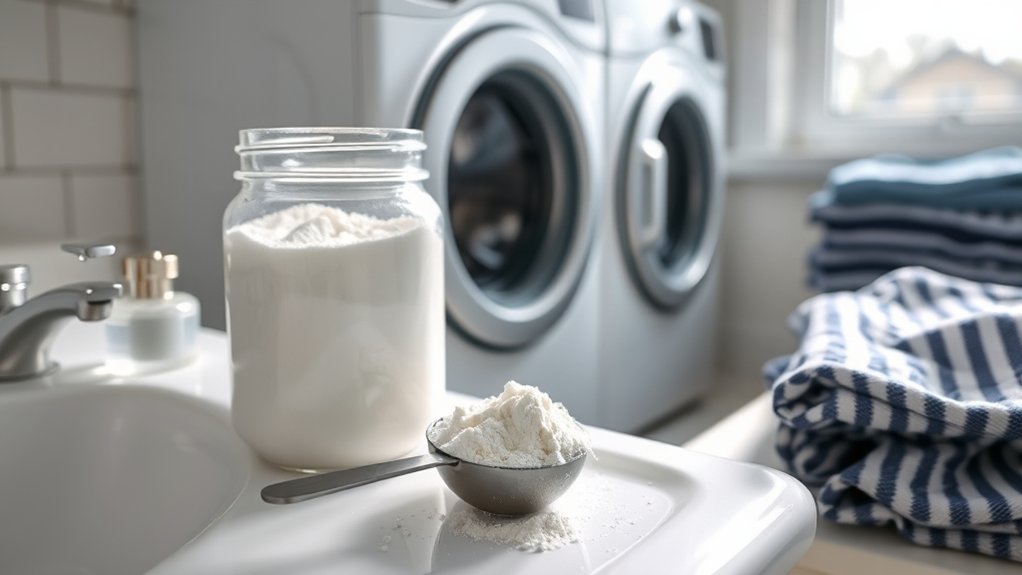
How much Borax should you add per load to achieve ideal cleaning results? For standard laundry loads, you should add between 1/4 and 1/2 cup of Borax directly into the washer drum. This range optimizes Borax’s cleaning power and water-softening capabilities without overuse.
If you’re handling larger capacity machines, increase the Borax amount to 3/4 cup per load to maintain thorough cleaning performance.
When treating specific stains before washing, apply 1 tablespoon of Borax per gallon of water as a pre-soak solution.
Always follow product labels carefully and avoid combining Borax with chlorine bleach to prevent harmful chemical reactions.
Precise measurement and correct application are essential to harness Borax’s full efficacy in your laundry cycle.
How Water Hardness Changes Borax Amounts
Since water hardness directly affects detergent performance, you’ll need to adjust Borax amounts accordingly to maintain ideal cleaning. Borax helps neutralize minerals in hard water that reduce detergent efficiency and cause soap scum.
The harder your water, the more borax you should add to optimize stain removal and fabric care.
| Water Hardness (gpg) | Borax Amount per Load | Effectiveness Impact |
|---|---|---|
| 0-3 (Soft) | ¼ cup | Detergent already effective |
| 3-7 (Moderate) | ½ cup | Enhances stain removal, boosts cleaning |
| 10-20 (Hard) | ¾ cup | Essential to counteract mineral buildup |
Adjusting borax helps maximize cleaning power without risking fabric damage from excess use.
Adjusting Borax for Load Size and Soil Level
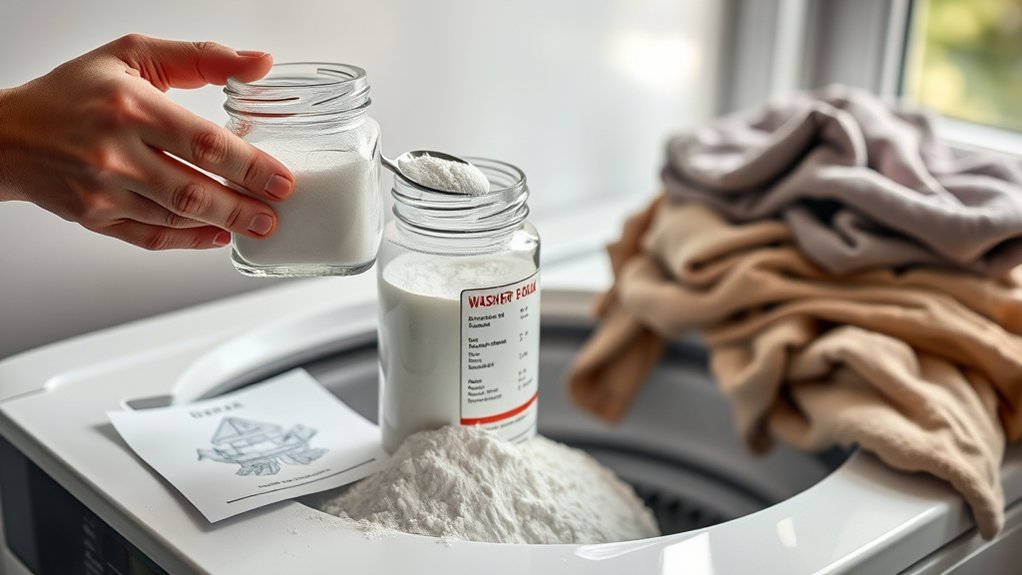
When you adjust borax amounts for load size and soil level, you enhance both cleaning efficiency and fabric care. For standard loads, adding 1/4 to 1/2 cup of borax works effectively to soften water and improve stain removal.
Heavily soiled loads demand up to 3/4 cup to maintain peak cleaning performance. Conversely, small or lightly soiled loads require only 1/8 to 1/4 cup to avoid overloading the washer while preserving borax’s work efficacy.
Always add borax during the wash cycle to maximize its chemical action. Furthermore, consider water hardness. Harder water may necessitate slight increments to maintain borax’s effectiveness.
How Borax Boosts Your Detergent’s Cleaning Power
Fine-tuning the amount of borax in your laundry not only adjusts for load size and soil level but also greatly enhances your detergent’s cleaning capabilities.
Borax optimizes washing by:
Borax enhances washing by softening water, raising pH, stabilizing enzymes, and preventing soil redeposition.
- Softening hard water: Borax neutralizes minerals that inhibit detergent action, ensuring better lather and soil removal.
- Raising pH: By increasing water’s pH to around 8, borax creates an alkaline environment that breaks down grease and oils more effectively.
- Stabilizing enzymes: Borax preserves detergent enzymes, maintaining their activity across multiple washes for consistent performance.
Additionally, borax prevents soils from redepositing on fabrics, which improves stain removal.
It also acts as a deodorizer to eliminate odors. Incorporating borax consequently maximizes detergent efficiency through chemical enhancement and physical soil control.
Should You Add Borax in Hot or Cold Water?
Although water temperature influences many aspects of laundry, borax remains effective whether you add it to hot or cold water. Borax enhances detergent performance by raising water pH, improving the dissolution of dirt and stains across temperature ranges.
When using hot water, a standard dosage of ½ cup per load optimizes cleaning efficiency. In cold water, the same ½ cup amount effectively softens water and boosts detergent action, compensating for lower temperatures.
You should monitor your laundry outcomes and adjust borax quantity as needed, especially considering varying water hardness.
Ultimately, borax’s chemical properties function consistently in both hot and cold water, giving you flexibility without sacrificing cleaning power.
This guarantees you can tailor borax use based on your specific laundry conditions.
Using Borax Safely on Different Fabrics
You’ll want to adjust how much Borax you use depending on the fabric type to avoid any damage. For example, cotton and polyester blends can handle about 1/4 to 1/2 cup per load.
But if you’re dealing with delicate fibers, it’s best to use diluted solutions instead.
It’s always a good idea to test Borax on a hidden spot first, just to make sure there aren’t any adverse effects.
And remember, you should avoid using Borax on acetate and triacetate fabrics altogether.
Also, keep Borax out of reach of children and pets since it can be an irritant.
Taking these precautions will help you use Borax safely and effectively on your laundry.
Fabric Compatibility Guidelines
When using borax in laundry, you should always test it on a small, hidden area of the fabric first to identify any potential discoloration or damage.
Borax is compatible with most durable fabrics like cotton but requires caution with delicate fibers such as silk or rayon, which may deteriorate upon exposure.
To optimize fabric compatibility, follow these guidelines:
- Use 1/4 to 1/2 cup of borax per load, making sure it dissolves completely before adding fabrics, especially delicate ones.
- Avoid combining borax with chlorine bleach to prevent harmful chemical reactions.
- For color-sensitive fabrics, reduce borax concentration or wash them separately to mitigate dye bleeding risks.
Adhering to these protocols guarantees you utilize borax effectively without compromising fabric integrity.
Safety Precautions Overview
Since borax can interact differently with various fabrics, you must implement specific safety precautions to prevent damage and guarantee effective cleaning. Always test borax on a small, hidden fabric area to detect discoloration or damage before full use.
For delicate materials like silk, use a diluted borax solution to minimize fiber stress. Never mix borax with chlorine bleach, as this produces hazardous fumes.
Adhere strictly to the recommended borax dosage of 1/4 to 1/2 cup per load to balance cleaning efficacy and fabric integrity.
Furthermore, store borax safely out of children’s and pets’ reach, since it can irritate skin and eyes.
These technical precautions ensure you use borax effectively while preserving fabric quality and maintaining household safety.
What Happens If You Use Too Much Borax?
If you use too much borax, your fabrics might end up with a residue that makes them stiff or even causes discoloration, especially on darker materials.
It’s not just about how your clothes look, though. Too much borax can also create a lot of suds, which could lead to leaks or even damage your washing machine.
Fabric Damage Risks
Although borax enhances cleaning efficiency, adding too much can compromise your laundry’s integrity. The fabric damage risks from excessive borax usage are significant and measurable.
You should adhere to recommended dosages, typically 1/4 to 1/2 cup per load, to prevent adverse effects.
Key fabric damage risks include:
- Fiber weakening and discoloration, especially in delicate materials like silk and cotton, due to pH imbalance.
- Residue buildup causing stiffness and a scratchy texture, which reduces fabric softness post-wash.
- Potential irreversible damage from overexposure, so it’s important to test borax on a small fabric area first.
Washing Machine Impact
Exceeding the recommended borax amount doesn’t just risk fabric damage; it also impacts your washing machine’s operation.
Using more than ½ cup of borax per load leads to excessive sudsing, which can cause leaks and impair mechanical components.
Borax residue accumulates inside your machine, so you’ll need extra cleaning cycles to prevent buildup that compromises performance.
Plus, overly alkaline conditions from too much borax reduce laundry detergent effectiveness, which hurts wash quality.
Frequent overuse may void warranties and increase maintenance needs, especially in high-efficiency washers designed for precise detergent dosing.
To keep your machine working well and lasting longer, stick to the borax guidelines.
Avoiding excess borax protects both your appliance and your laundry results.
This way, you ensure efficient operation and prevent costly repairs or fabric issues.
Can You Use Borax With Other Laundry Additives?
When combining borax with other laundry additives, you need to be cautious about chemical interactions that can reduce cleaning effectiveness or pose safety risks.
You can safely use borax to enhance your detergent’s cleaning power, but avoid mixing it directly with bleach, as this can produce harmful fumes.
Also, never combine borax with vinegar since their acid-base reaction neutralizes their effectiveness.
Here are key points to take into account when you use borax with other laundry additives:
- Add ½ cup of borax per load alongside your regular laundry detergent for improved stain removal and water softening.
- Combine borax with oxygen bleach only if product instructions permit, ensuring safe and suitable results.
- Adjust borax and additive amounts based on water hardness and specific laundry needs to maximize cleaning power.
Tips for Accurately Measuring and Adding Borax
To achieve consistent cleaning results, you should measure borax carefully according to your load size and soil level. Use 1/4 to 1/2 cup for standard loads, adjusting to 3/4 cup for larger machines or heavily soiled laundry to enhance cleaning efficacy.
Always pour borax directly into the washer drum before adding clothes. This guarantees even distribution during the wash cycle.
Avoid combining borax with chlorine bleach in the same cycle to prevent hazardous fumes. Use them separately.
Follow the product label instructions precisely and perform a patch test on a small, inconspicuous fabric area to detect any potential damage.
Accurate measurement and proper addition of borax optimize its performance, assuring consistent, safe, and effective laundry results.
When to Use More Borax for Tough Stains
Adjusting the amount of borax based on stain severity can markedly boost your laundry’s cleaning performance. When tackling tough stains like grease, oil, or mildew, you’ll want to increase borax dosage strategically for peak results.
Consider these guidelines:
- Add 1/2 cup of borax directly to the washer drum for typical tough stains to enhance detergent efficacy.
- For heavily soiled garments, use up to 3/4 cup of borax to maximize cleaning power.
- For targeted stain treatment, mix 1 tablespoon of borax per gallon of water and apply directly before washing.
Using borax this way guarantees it dissolves efficiently, activating its stain-fighting properties.
Adjusting borax quantities precisely helps you handle persistent odors and stubborn soils effectively, improving overall laundry outcomes.
Frequently Asked Questions
Can Borax Help With Mold or Mildew Smells in Laundry?
Yes, borax effectively neutralizes mold and mildew smells in laundry by raising water pH and enhancing detergent performance.
You can add about 1/2 cup of borax to your wash to combat stubborn odors.
Its alkaline properties disrupt odor-causing bacteria and help loosen soil particles, preventing them from redepositing on fabrics.
Using borax regularly will improve freshness, especially in towels and sportswear prone to mildew, ensuring a thorough odor elimination.
Is Borax Safe for Septic Systems and Wastewater Treatment?
Yes, borax is safe for septic systems and wastewater treatment when you use it sparingly. It breaks down naturally and doesn’t disrupt the beneficial bacteria essential for waste processing.
However, avoid overusing borax, as excessive amounts can upset microbial balance.
To protect your system, limit borax to occasional laundry use and maintain regular septic monitoring. This approach guarantees borax won’t harm your septic environment or treatment efficiency.
How Does Borax Affect the Environment When Disposed Of?
Borax affects the environment like a gentle breeze—usually harmless but potentially disruptive in excess. When you dispose of it properly, it breaks down into non-toxic elements like sodium and boron.
However, if you dump too much, boron levels can rise, harming aquatic plants and organisms.
Can Borax Be Used for Hand-Washing Clothes Effectively?
Yes, you can use borax effectively for hand-washing clothes. It acts as a water softener and boosts detergent performance by neutralizing hard water minerals.
To get the best cleaning results, dissolve about 1 tablespoon of borax per gallon of warm water before washing. This helps break down dirt and stains more efficiently.
Just make sure to rinse clothes thoroughly afterward to remove any borax residue and avoid skin irritation.
Does Borax Have Any Impact on Colorfastness of Dyed Fabrics?
Borax can boost your laundry’s cleaning power but risks dulling your colors. Its alkaline nature raises pH, which enhances stain removal yet may weaken dyes, especially reactive or direct ones.
You should test borax on a hidden area first because even small amounts might cause fading or bleeding.
Use it cautiously, around 1/4 to 1/2 cup per load, and never mix with chlorine bleach to protect your fabrics’ colorfastness effectively.
Conclusion
You want your laundry clean but not overwhelmed. Too little borax leaves stains, and too much risks residue. Picture a precise balance: a small scoop against a full load, soft water versus hard, cold versus hot cycles.
Adjusting borax is like tuning a machine for maximum efficiency. Just enough to boost detergent without excess. By measuring carefully and considering load size and water hardness, you guarantee ideal cleaning power without compromising fabric or washing machine performance.