What Laundry Detergent Works For Slime – A Closer Look
You’ll want laundry detergent containing sodium borate to make slime because it crosslinks glue polymers, creating the right texture and stretchiness. Detergents like Tide Free & Clear reliably have this ingredient, while brands like Gain do not, resulting in sticky or inconsistent slime.
Checking labels for sodium borate or boric acid is crucial before testing. Precise detergent amounts affect slime consistency, and proper handling guarantees safety and longevity.
Keep exploring to optimize your slime formulation and care.
Key Takeaways
- Laundry detergents containing sodium borate, like Tide Free & Clear, effectively activate slime by crosslinking glue polymers.
- Detergents without sodium borate, such as Gain and some “free and clear” formulas, typically fail to produce proper slime.
- Checking ingredient labels for borax or boric acid ensures the detergent’s suitability for slime making.
- Adjust detergent amounts gradually during slime preparation to achieve the desired texture and consistency.
- Safe slime handling includes storing in airtight containers and using gloves or gentle detergents to avoid skin irritation.
How Laundry Detergent Makes Slime
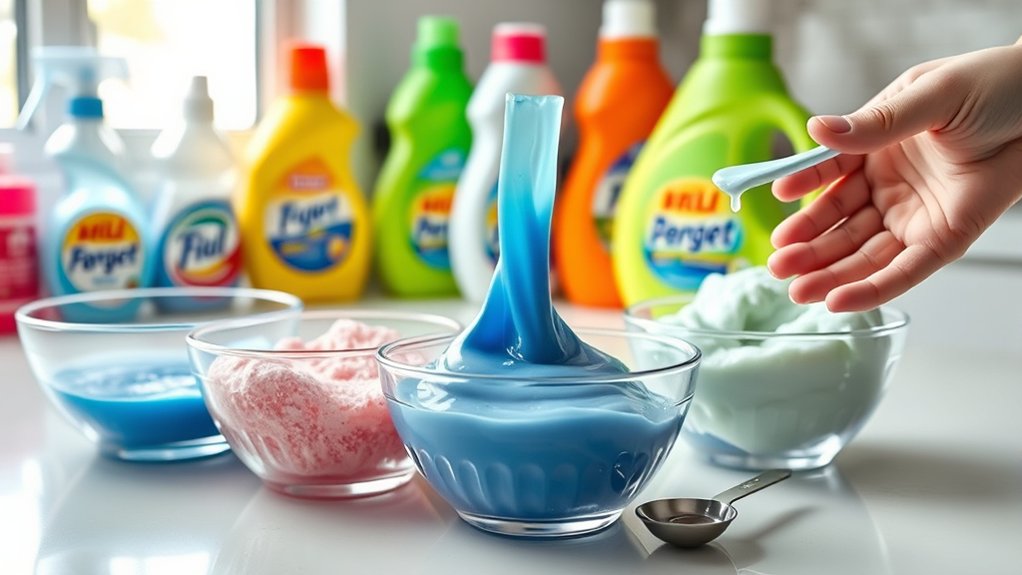
Although various ingredients can activate slime, laundry detergent plays a critical role by acting as a binding agent through its sodium borate content.
When you mix slime with laundry detergent, the sodium borate or boric acid reacts with polyvinyl acetate in glue, cross-linking polymer chains into a stretchy, cohesive network.
The detergent’s surfactants also reduce glue’s surface tension, promoting thickening and malleability.
It’s essential to choose laundry detergents containing sodium borate or boric acid, as detergents lacking these components, like some Gain formulas, fail to form proper slime.
Different brands vary in effectiveness; Tide Free & Gentle performs reliably.
Adjusting detergent quantity, typically between one and two tablespoons, lets you control slime viscosity and elasticity.
Understanding these interactions helps you optimize slime texture systematically and reproducibly.
Why Sodium Borate Matters for Slime
Because sodium borate functions as a crosslinking agent, it directly influences the molecular structure of slime by bonding polyvinyl acetate chains in glue.
Without this bonding, slime remains sticky and lacks cohesion.
When selecting a laundry detergent, you should focus on its sodium borate content, as it determines slime quality. For example, Tide Free contains sodium borate, making it effective in slime production, unlike some detergents lacking this ingredient.
Consider these points:
- Sodium borate facilitates the stretchy, cohesive texture characteristic of slime.
- Detergents without sodium borate often yield inconsistent slime results.
- The concentration of sodium borate in laundry detergent affects slime’s final texture.
- Always verify ingredient lists to confirm sodium borate presence when choosing a laundry detergent for slime.
This knowledge helps you optimize slime-making outcomes with the right detergent.
Top Laundry Detergents for Making Slime
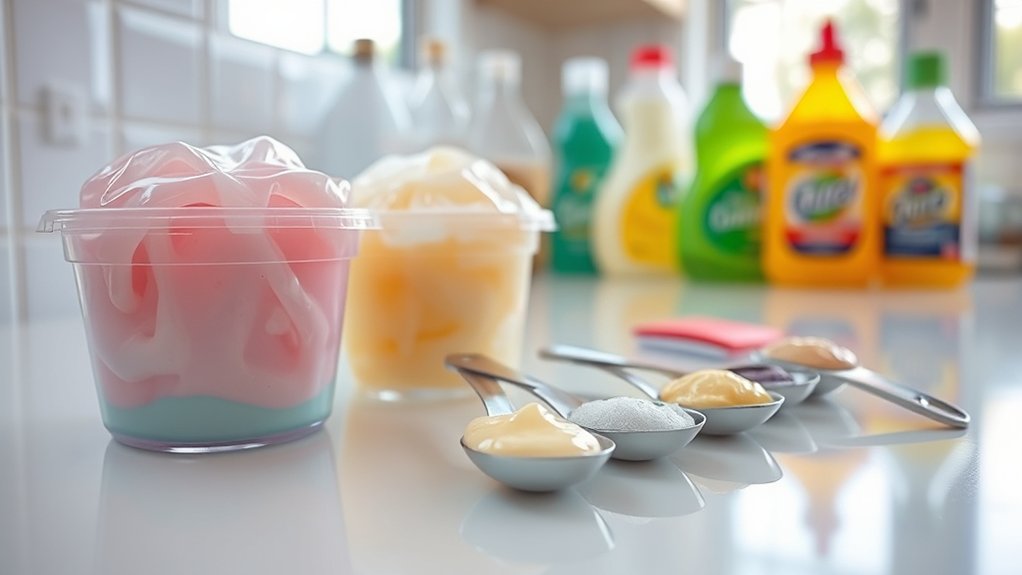
When choosing a laundry detergent for slime, you need to prioritize those containing sodium borate or its equivalents, such as borax or boric acid. These compounds facilitate the crosslinking essential for slime formation.
Tide Free & Clear stands out as a reliable laundry detergent due to its sodium borate content, making it a preferred option for slime recipes.
While some detergents like Gain lack these critical ingredients and fail to produce slime, alternatives such as Formil Bio and Ultra Ariel Liquid Detergent have demonstrated effectiveness in specific regions.
Previously, 7th Generation detergent showed promise but now exhibits inconsistent results.
Always scrutinize ingredient labels for borax, sodium tetraborate, or boric acid to confirm your chosen detergent supports the chemical reactions necessary for ideal slime texture and elasticity.
Detergents That Don’t Work and Why
Not all laundry detergents will produce slime because they lack critical activators like sodium borate or boric acid.
When making this slime, you’ll find detergents that don’t work often miss these key ingredients, resulting in poor or no slime formation.
Detergents lacking key ingredients often fail, causing little to no slime formation.
Here’s what to watch out for:
Detergents labeled “gentle” or “free and clear” frequently omit boric acid or sodium borate.
Brands like Gain don’t contain sodium borate, failing to activate slime polymers.
Some once-effective detergents, such as 7th Generation, may have reformulated and lost sodium borate.
Always verify ingredient lists, as formulations change and affect slime efficacy.
Understanding these factors helps you avoid ineffective products and guarantees successful slime activation by relying on detergents containing sodium borate.
How to Test Your Laundry Detergent for Slime
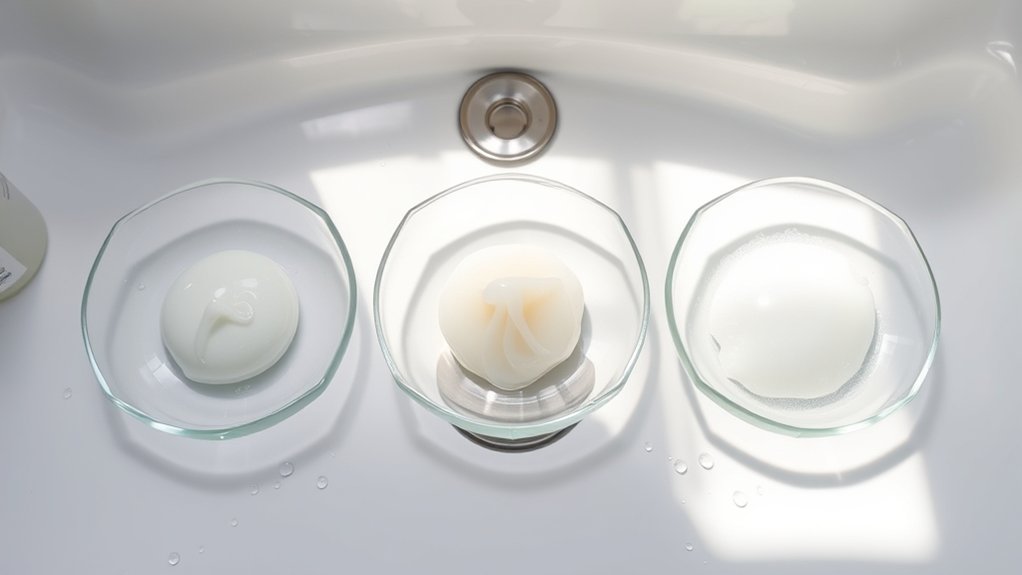
First, take a look at the detergent’s ingredient label to see if it contains sodium borate or boric acid—these are key ingredients for making slime.
Then, try mixing equal parts of glue and detergent in a small test batch. This will help you check if the mixture turns into slime.
If the slime feels sticky, you can slowly add more detergent little by little.
Make sure to keep track of what happens so you can compare how well different brands work.
Detergent Ingredient Check
Although many laundry detergents claim to work for slime, you need to verify the presence of key ingredients like sodium borate, borax, or boric acid in the formulation.
Conduct a detergent ingredient check before use to confirm slime compatibility. Here’s how to proceed:
Review the ingredient list on your laundry detergent label for sodium borate or boric acid. Recognize that brands like Tide Free & Clear contain these essential components, while others like Gain do not.
Consider region-specific alternatives such as Formil Bio or Ultra Ariel Liquid Detergent, reported effective.
Avoid detergents lacking these ingredients, as they won’t facilitate proper slime formation.
This precise ingredient verification prevents trial and error, saving time and guaranteeing your slime achieves ideal texture and cohesion.
Slime Formation Test
When you want to confirm a laundry detergent’s effectiveness for slime, you’ll conduct a slime formation test by combining a small amount of detergent with glue and observing the reaction.
Begin by mixing liquid laundry detergent, ideally one containing sodium borate or boric acid, with your slime recipe’s glue base. If the mixture thickens and forms a cohesive mass, the detergent is suitable. If it remains watery or fails to bind, the detergent lacks essential slime-forming agents.
Test multiple brands, such as Tide Free & Gentle or non-bio detergents, to compare results.
Always follow safety precautions: wear gloves and work in a well-ventilated area to avoid skin irritation or inhalation of fumes.
Document each test’s outcome to refine your slime recipe and identify the most effective laundry detergent.
Adjusting Detergent Amounts for Perfect Slime
Because laundry detergents vary in concentration and formulation, you’ll need to add them incrementally to achieve the ideal slime consistency. Start with 1 tablespoon of laundry detergent, mixing thoroughly until the slime is no longer sticky. If stickiness persists, add ½ teaspoon more and knead well to incorporate.
To adjust texture without compromising structure, introduce 1 teaspoon of warm water for softness. Monitor the slime closely, as detergent potency differs by brand.
- Begin with a base amount of detergent to avoid over-activation
- Add detergent in small increments to control stickiness precisely
- Knead consistently to guarantee uniform distribution of detergent
- Adjust with warm water for a pliable, non-rigid slime
This measured approach guarantees you achieve perfect slime with ideal texture.
Troubleshooting Common Detergent-Related Slime Issues
First, you want to check if your laundry detergent has sodium borate or boric acid—these ingredients are key for getting your slime to activate properly.
If you find your slime is either too sticky or too stiff, try tweaking the amount of detergent you use or add a bit of warm water to fix the texture.
And if the slime just won’t come together at all, it might be time to switch to a different detergent brand since their ingredients can vary quite a bit.
Detergent Ingredient Importance
Although many laundry detergents claim versatility, only those containing sodium borate compounds, such as borax, sodium tetraborate, or boric acid, effectively create the cross-linking necessary for proper slime consistency.
When selecting a detergent, scrutinize ingredient labels to confirm the presence of these compounds. Without sodium borate, slime won’t form correctly.
Keep these points in mind:
- Detergents like Tide Free & Clear contain boric acid, which helps slime formation.
- Brands lacking sodium borate, such as Gain, typically fail to activate slime properly.
- If slime is too sticky, knead in about ½ teaspoon more detergent to adjust the texture.
- Adjust glue-to-detergent ratios to fix lumps or curdling, making it smooth.
Understanding detergent ingredients is essential for troubleshooting and achieving ideal slime consistency.
Common Slime Texture Problems
When slime exhibits texture issues, these often stem from improper detergent use or incorrect glue-to-detergent ratios. If your slime is too sticky, add ½ teaspoon increments of laundry detergent, kneading thoroughly after each addition to achieve proper consistency.
Conversely, if the slime is overly stiff, carefully incorporate 1 teaspoon of warm water to loosen its texture.
Should your slime fail to form, it’s likely due to detergent inefficacy; switching to a laundry detergent containing sodium borate can resolve this.
Texture problems frequently arise from these ratio imbalances, so precise adjustments are critical.
Furthermore, be aware that some detergents may irritate skin. Wash immediately if this occurs and consider using gloves or gentler detergent brands.
Monitoring glue-to-detergent proportions is essential for the best slime texture.
Safe Slime Storage and Handling Tips
To preserve slime’s texture and prevent contamination, store it in an airtight container at room temperature. This keeps moisture in and stops mold growth for up to one to two weeks.
For safe storage and handling tips, consider the following:
Regularly check slime for unpleasant odors or visible mold. If you notice any, throw it away to avoid health risks.
If slime gets sticky, knead in 2-3 drops of laundry detergent to bring back its original feel.
Always wash your hands with soap and water after handling slime to prevent skin irritation.
Keep slime away from young children and pets since swallowing it can be dangerous.
Using an airtight container ensures the best preservation, and these handling tips help reduce contamination and keep slime usable.
Frequently Asked Questions
Can Fabric Softeners Be Used Instead of Detergent for Slime?
No, you can’t use fabric softeners instead of detergent for slime. Fabric softeners lack essential ingredients like sodium borate or boric acid.
These ingredients create slime’s texture by cross-linking polymers. Their chemical makeup is designed to soften fabrics, not bind slime components.
Using softeners leads to sticky or watery slime, ruining consistency. To get proper slime, you need laundry detergents containing these active compounds for effective polymer interaction.
Does Detergent Color Affect Slime Quality?
Color in detergent is just the icing on the cake; it doesn’t affect slime quality. What matters are the active ingredients like sodium borate or boric acid, which create the slime’s structure.
While colored detergents can tint your slime, they won’t change its stretchiness or texture if those key compounds are present.
How Does Water Temperature Impact Detergent’s Slime Activation?
Water temperature directly influences how effectively the detergent activates slime. When you use warm water, around 100°F (38°C), it dissolves the detergent’s sodium borate more efficiently, enhancing its reaction with PVA glue. This results in a smoother, more cohesive slime.
Conversely, cold water slows this interaction, causing a stickier, less elastic texture.
To optimize slime consistency, you should control water temperature carefully during the mixing process.
Can Powdered Detergent Be Used for Making Slime?
Sure, you *can* use powdered detergent for slime, but don’t expect a smooth ride.
Powders often struggle to dissolve evenly, messing with the slime’s texture and consistency.
Unless that powder specifically contains boric acid and dissolves well, you’ll end up with a clumpy mess.
Liquid detergents remain your best bet, delivering precise activation and a consistent, stretchy slime.
Is Homemade Detergent Effective for Slime Making?
Homemade detergent usually isn’t effective for slime making because it often lacks sodium borate or boric acid, key activators in the slime formation process.
You’ll find ingredients like baking soda and vinegar don’t provide the necessary chemical bonds.
To reliably create slime, you need a commercial detergent with the right active ingredients.
Without these, your slime won’t reach the proper consistency or stretchability you’re aiming for.
Conclusion
When making slime, choosing the right laundry detergent is essential, as its sodium borate content activates the slime’s polymerization. Remember, not all detergents work the same. Testing small amounts helps you find the perfect balance.
As the saying goes, “You can’t make an omelet without breaking eggs,” so don’t hesitate to experiment carefully. With precise adjustments and proper handling, you’ll achieve consistent, satisfying slime every time.