How To Fold Laundry – Full Guide
To fold laundry efficiently, squeeze out excess air and fold clothes uniformly to create slim, compact bundles that fit neatly in drawers. Fold tees by bringing sleeves inward and folding in thirds. Pants and shorts should be folded symmetrically and stacked upright.
Use consistent techniques for undergarments and socks, grouping similar items into category-specific bundles. Keep towels and linens compact by folding into rectangles. Mastering these steps streamlines storage and speeds up laundry tasks.
Explore more ways to organize every garment type.
Why Proper Folding Saves Space and Simplifies Storage
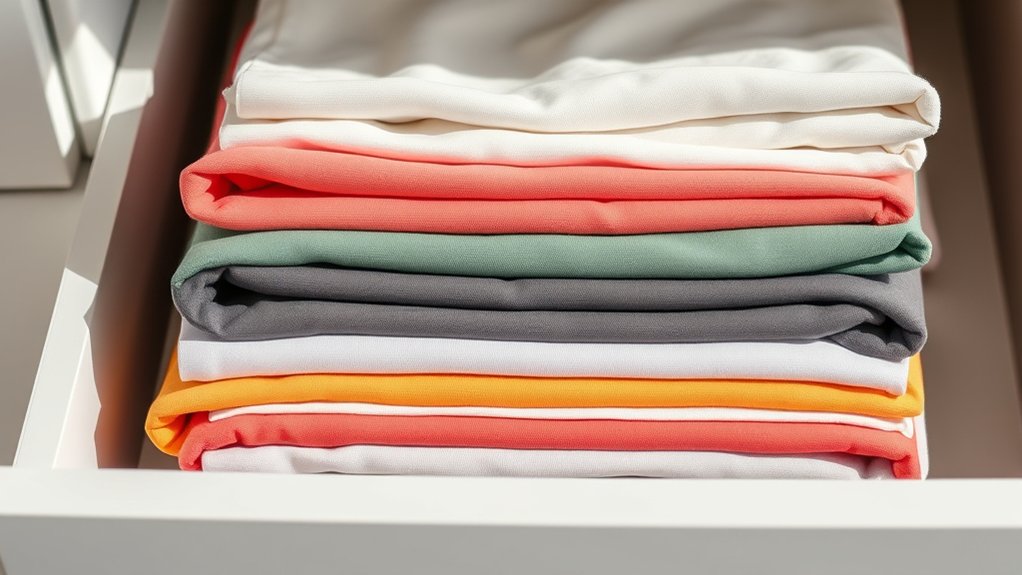
When you fold your laundry properly, you can increase drawer space by up to 50% by creating compact, uniform stacks. This space-saving technique, like file folding, helps you organize clothes neatly and separate them by type.
When clothes are folded consistently, you can quickly spot and access what you need, streamlining your daily routine.
Proper folding also keeps items stable and prevents them from toppling or tangling, making storage maintenance effortless.
Besides saving space, neatly folded laundry reduces wrinkles and creases, which cuts down on ironing time.
By adopting these systematic folding habits, you optimize your storage and keep your wardrobe tidy.
In the end, it saves you time and effort every day.
Prevent Wrinkles and Keep Laundry Fresh While Folding
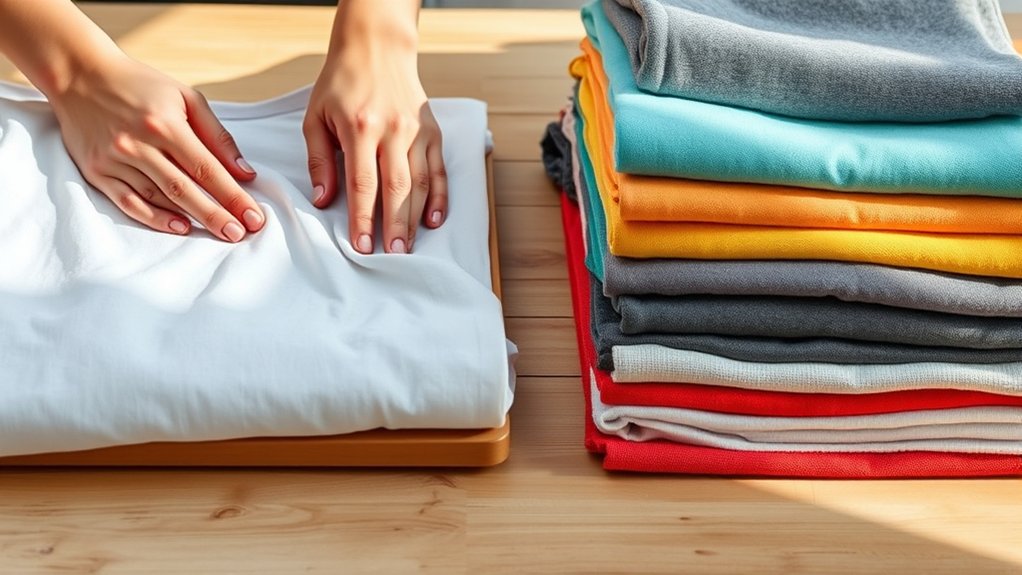
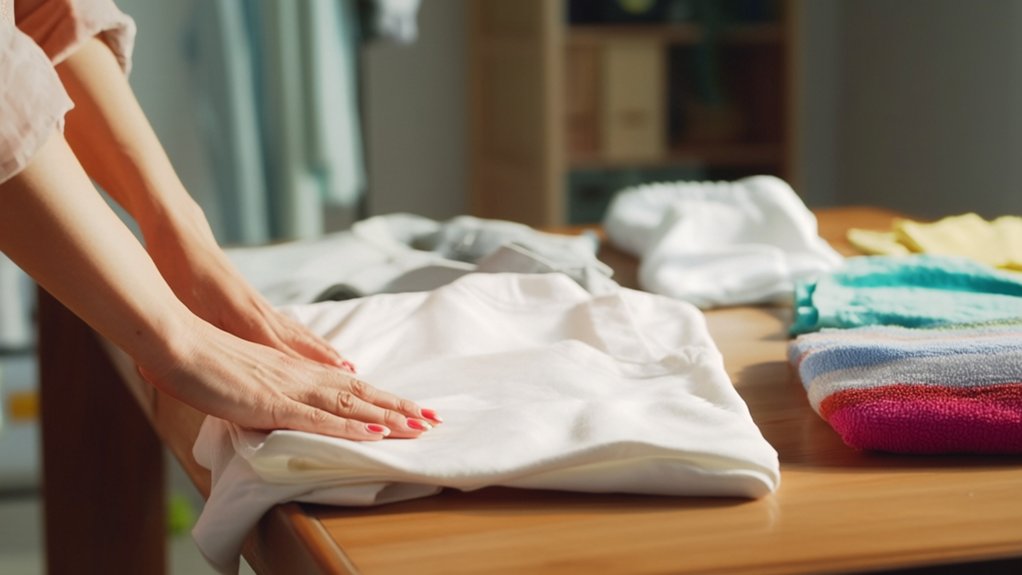
Folding your laundry within five minutes of drying prevents wrinkles from setting and keeps clothes looking fresh. Start by giving each item a quick shake to release any leftover wrinkles and align seams for a smoother fold. Use a flat, ergonomic surface like a countertop to reduce strain and make folding easier.
Sort clothes by fabric type and weight so you don’t crush lighter fabrics, which helps keep them crisp. For delicate or structured garments, follow care labels carefully. Nest and fold them gently to minimize creasing and maintain their shape.
How to Fold T-Shirts and Tank Tops for Neat Stacks
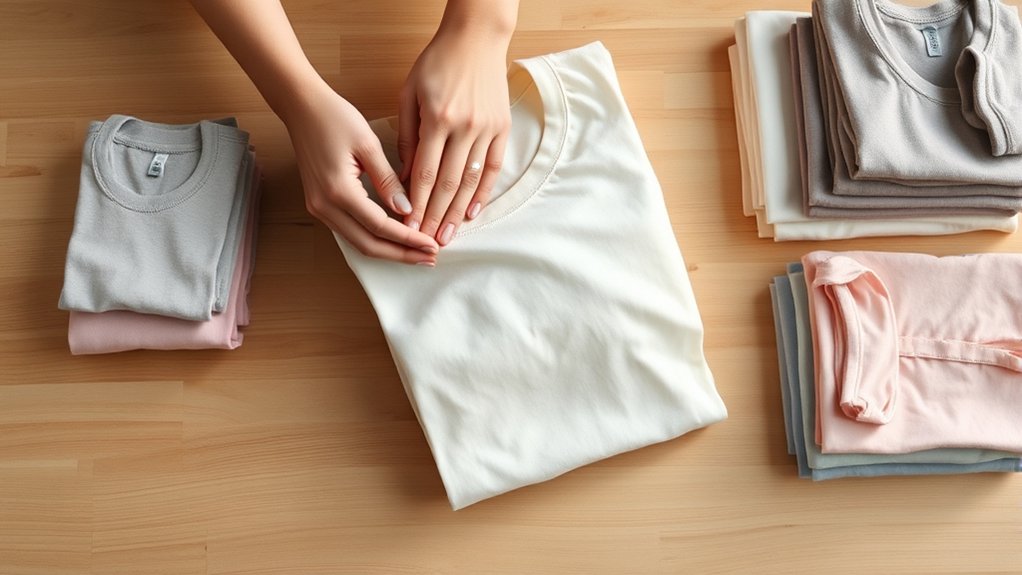
Because folding T-shirts and tank tops right after drying prevents wrinkles, you’ll want to start by laying each garment flat on a smooth surface.
Folding your T-shirts and tank tops immediately after drying helps keep them wrinkle-free and ready to wear.
Next, fold each side toward the center, creating a long, narrow rectangle. For T-shirts, fold the sleeves inwards so they align with the sides, forming a clean rectangular shape.
Then, fold the bottom of the shirt up toward the collar in thirds or quarters, depending on the size, to make a compact bundle. Use consistent measurements, like a thumb-width gap from the collar, to guarantee all your shirts look uniform when stacked.
Folding immediately after drying sets creases and keeps your stacks neat, saving you time when you dress or pack. This method works well for both T-shirts and tank tops.
How to Fold Pants, Shorts, and Athletic Wear Neatly
Start by folding pants with the back pockets facing out. Then, tuck the crotch seam inward so you get a smooth, flat shape.
When it comes to athletic shorts, fold them twice with the back side out. Make sure to align the crotch seam to keep everything from slipping around.
Keeping seams straight and making sure different fabrics don’t get mixed up will really help you maintain a neat, organized stack.
Pants Folding Techniques
When you fold pants, shorts, or athletic wear, make certain the back pockets face outward and all zippers and buttons are closed to keep everything neat.
For full-length pants, fold them in half from the hem to the waistband, then fold again into a compact rectangle. Tuck in the crotch seam to avoid bulk.
Shorts should be folded at the crotch seam to maintain symmetry, then rolled or folded similarly to pants for a consistent look. Keep different styles separated to prevent creases and maintain organization.
Athletic wear requires folding twice with the back out, folding from waistband to hem to avoid slipping.
Following these steps ensures your pants and shorts stay tidy, saving space and making your drawers easier to manage. It’s a simple way to keep everything looking sharp and easy to find.
Athletic Shorts Handling
Three simple steps will help you fold athletic shorts neatly and keep your drawer organized. First, lay your shorts flat. Smooth out the waistband to prevent bunching.
Next, fold each side inward, turning the shorts inside out with the back side facing you. Align the seams for uniformity.
Finally, fold the shorts in half or thirds from the waistband down. This creates a compact rectangle.
| Step | Action | Tip |
|---|---|---|
| 1 | Lay flat, smooth waistband | Prevents bunching |
| 2 | Fold inward, back side out | Maintains shape, prevents slip |
| 3 | Fold in half or thirds | Creates compact, uniform shape |
| Consistency | Use same method for all shorts | Keeps drawer organized |
| Finish | Stack with label facing up | Easy identification |
Folding Undergarments and Socks for Consistency and Space
Although folding small items like undergarments and socks might seem trivial, doing it systematically saves space and keeps your storage neat.
Fold briefs and boxers into thirds, stacking them into compact squares for efficient storage.
Fold briefs and boxers into thirds, creating compact squares that save space and keep your drawers tidy.
For female underwear, bring the sides to the center, then fold in half to create a neat square.
Fold bras once from left to right, then top to bottom, making sure the cups stay supported to keep the stack tidy.
Use the “pillowcase” method for tank tops to maintain shape and consistency.
For socks, apply the “box method”: stack pairs and fold from toe to cuff, creating uniform, space-saving bundles.
Following these steps will keep your drawers organized and maximize space efficiently.
It’s a simple way to make your storage look neat and feel more manageable.
Give it a try—you’ll notice the difference right away!
Tips for Folding Kids’ Clothes and Linens Quickly and Neatly
Mastering the folding techniques for undergarments and socks lays a solid foundation for handling kids’ clothes and linens. Start by grouping kids’ clothes by size and type. Keep tops with tops and bottoms with bottoms to speed up folding and organizing.
Fold kids’ shirts like adult T-shirts. Fold three times from the top without stretching, using thumb measurements for consistency.
Fold underwear into neat squares or rectangles, stacking them uniformly for easy drawer access.
For linens, fold sheets tightly into thirds and pillowcases into small rectangles to save space.
Always use a flat, stable surface at waist height to fold efficiently. This reduces strain and ensures uniform folds.
This method keeps kids’ clothes and linens tidy and easy to store. It really makes a difference when you want everything to look neat and be accessible.
Give it a try and see how much easier organizing becomes!
How to Fold Towels and Sheets for Compact Storage
How do you fold towels and sheets to save the most space? Start by folding towels once lengthwise to form a long rectangle. Then, fold them into thirds or quarters, creating a compact, uniform shape.
For sheets, fold the long sides inward to make a neat rectangle. If it’s a fitted sheet, tuck the corners together and fold it into a small rectangle. This often fits inside its matching pillowcase.
Next, fold sheets into thirds or quarters depending on your available storage space. Smooth out wrinkles or lightly iron fabrics during folding to keep everything flat and tidy.
Consistently making small, precise folds maximizes storage efficiency and helps maintain an organized linen closet. It also makes it easier to find and access your towels and sheets.
How to Package Laundry Into Drawer-Ready Bundles
To package laundry into drawer-ready bundles, start by folding your items into compact, uniform shapes. This way, they can stand upright, making it super easy to grab what you need. Try using file folding techniques—they really help keep everything neat and tidy.
Also, don’t forget to squeeze out any excess air while folding. It keeps your bundles slim and organized, so your drawer won’t get overcrowded.
Finally, group similar items together and secure them with simple knots or labels. This little extra step makes your drawer storage way more streamlined and easy to navigate.
Effective Packaging Techniques
When you fold laundry uniformly and squeeze out as much air as possible, you create compact bundles that fit neatly into drawers. Start by pressing out excess air from each piece before folding to enhance compression. Use one functional knot to secure the bundle tightly, then add a cosmetic knot for a polished look.
Avoid plastic bags for damp items. Instead, use breathable bear hug bags to expel moisture and improve airflow.
Stack your folded clothes upright to maintain shape and ease retrieval.
Consistently applying these techniques guarantees your bundles stay intact, look neat, and maximize drawer space. By practicing uniform folding and secure packaging, you’ll maintain organized, drawer-ready bundles that simplify your daily routine.
Creating Organized Bundles
Although folding laundry is essential, creating organized bundles transforms chaotic piles into manageable, drawer-ready sets. Start by folding each item into a compact, upright rectangle using the KonMari method so it stands independently.
Group similar items, like t-shirts or underwear, together to form clear, category-specific bundles.
Keep your folding technique and item size consistent within each category to streamline stacking and organizing.
Next, place these neatly folded bundles into designated bags or boxes, preserving the order for easy retrieval.
Aim for bundles that are easy to handle with one hand, making transport and drawer placement quick and effortless.
Speed Up Folding Without Losing Quality
Even if you want to fold laundry quickly, maintaining neatness is essential. Speeding up doesn’t mean rushing or sacrificing quality. Instead, focus on consistent, efficient techniques that save time without creating wrinkles or mess.
To speed up folding without losing quality, practice folding in timed batches. Gradually increase your speed while keeping folds tidy. It’s all about finding that balance.
Use folding boards or guides for uniform, quick folds. These tools help reduce handling time and keep everything looking sharp.
Group similar items together to create a folding routine that minimizes decision-making.
Fold smoothly and confidently to avoid mistakes and re-folding. This way, you save time overall.
Adopting these habits helps you fold faster and keep clothes crisp. Laundry becomes a streamlined, manageable task before you know it.
Frequently Asked Questions
What Is the Best Detergent for Preventing Fabric Stiffness?
You should choose detergents with added conditioners or moisturizers, preferably eco-friendly or enzyme-based ones. Avoid using too much detergent to prevent residue buildup.
Also, consider liquid fabric softeners or vinegar rinses to keep fabrics soft and flexible. These little tricks really help your clothes feel better after washing.
How Do I Remove Stubborn Laundry Stains Effectively?
You remove stubborn stains by pre-soaking clothes in warm water with a stain remover for 30 minutes. Then, gently blot the area with cold water to lift the stain.
Using enzyme-based detergents works great for protein stains like blood or sweat. If the stain doesn’t come out right away, just repeat the treatment a few times until it fades. It takes a bit of patience, but it’s worth it!
Can I Fold Laundry While It’s Still Slightly Damp?
You can fold slightly damp laundry, but 70% of wrinkles set during drying. Fold quickly and store in a ventilated space to avoid mildew.
For best results, fold mostly dry clothes to keep them crisp. It’s really about timing—folding too early might cause more wrinkles or mildew. So, try to get them just right before folding.
What Storage Solutions Work Best for Seasonal Clothing?
You’ll want clear, labeled bins or vacuum-sealed bags to save space and protect clothes. Use adjustable shelving for easy access, and drawer dividers for accessories.
It’s a good idea to rotate items between storage and hanging racks to keep your wardrobe fresh. That way, you can easily find what you need and keep everything in good shape.
How Often Should I Clean My Washing Machine?
You should clean your washing machine at least once a month. For HE washers, run a cleaning cycle every 30 uses.
Also, wipe seals and dispensers after each use. This helps prevent buildup and keeps odors away. It’s a simple step that really makes a difference.
Conclusion
Folding laundry fast and flawlessly frees up your space and simplifies storage. By practicing proper techniques, you prevent pesky wrinkles and preserve freshness. From t-shirts to towels, pants to pajamas, consistent folding creates clean, compact collections.
Stick to simple steps, stay systematic, and speed up your sorting without sacrificing style. Start stacking smarter today. Save space, save stress, and streamline your storage with savvy, speedy folding skills!