Does Lysol Laundry Sanitizer Work – The Truth
You can trust Lysol Laundry Sanitizer to kill 99.9% of bacteria when used correctly, unlike regular detergents that mainly remove dirt without significant germ reduction. It’s effective in cold water, safe for delicates, and boosts your detergent’s antimicrobial power, especially with warm water and longer rinse cycles.
While it doesn’t replace bleach for heavy sanitization, it’s a solid supplement for hygiene. Understanding its best use and limits will clarify how it fits into your laundry routine.
Key Takeaways
- Lysol Laundry Sanitizer kills 99.9% of bacteria when used as directed, enhancing hygiene beyond regular detergents.
- It works effectively in cold water, is safe for delicates and baby clothes, and complements detergents without damaging fabrics.
- Optimal use requires adding Lysol during the rinse cycle with at least 16 minutes of rinse time and warmer water.
- Lysol is less potent than chlorine bleach and does not fully replace bleach for heavy bacterial elimination.
- Legal reviews confirm Lysol’s labeling claims are valid, but consumers should rely on proper usage and scientific evidence for best results.
Why Regular Detergents Don’t Always Sanitize Laundry
Although regular detergents like Kirkland Free and Clear effectively remove dirt and odors, they don’t greatly reduce bacteria levels in your laundry. Studies show these detergents yield minimal bacterial reduction, falling short of true sanitization.
Even washing machine Sanitize Cycles improve cleanliness but don’t match chlorine bleach’s disinfection power. Alternative additives such as Clorox 2 and OxiClean also lack reliable germ-killing effects in standard washes.
That’s where Lysol laundry sanitizer becomes valuable; when used per guidelines, it kills 99.9% of bacteria, enhancing laundry sanitation beyond detergent capabilities.
Since common items like towels and sportswear harbor harmful microbes, relying solely on detergents leaves you vulnerable.
Incorporating Lysol laundry sanitizer guarantees a targeted approach to bacterial elimination, addressing gaps left by regular detergents.
How Lysol Kills 99.9% of Bacteria
Lysol Laundry Sanitizer achieves its 99.9% bacteria kill rate by releasing antimicrobial agents during the rinse cycle. These agents disrupt bacterial cell membranes and inhibit reproduction.
When you add two capfuls to the fabric softener compartment or directly during rinsing, the agents penetrate fabrics, including delicates and baby clothes, even in cold water. This targeted action kills 99.9% of bacteria, reducing microbial load and preventing odor-causing organisms, especially in synthetic and athletic wear.
Adding two capfuls during rinsing kills 99.9% of bacteria, even on delicates and synthetic fabrics.
The sanitizer works synergistically with detergents like Norwex, enhancing bactericidal efficacy beyond its solo use.
While its performance is notable across fabric types, it remains less potent than chlorine bleach at elevated temperatures.
Nonetheless, Lysol’s mechanism guarantees significant bacterial elimination, supporting hygienic laundry outcomes without fabric damage.
How Effective Is Lysol Compared to Bleach?
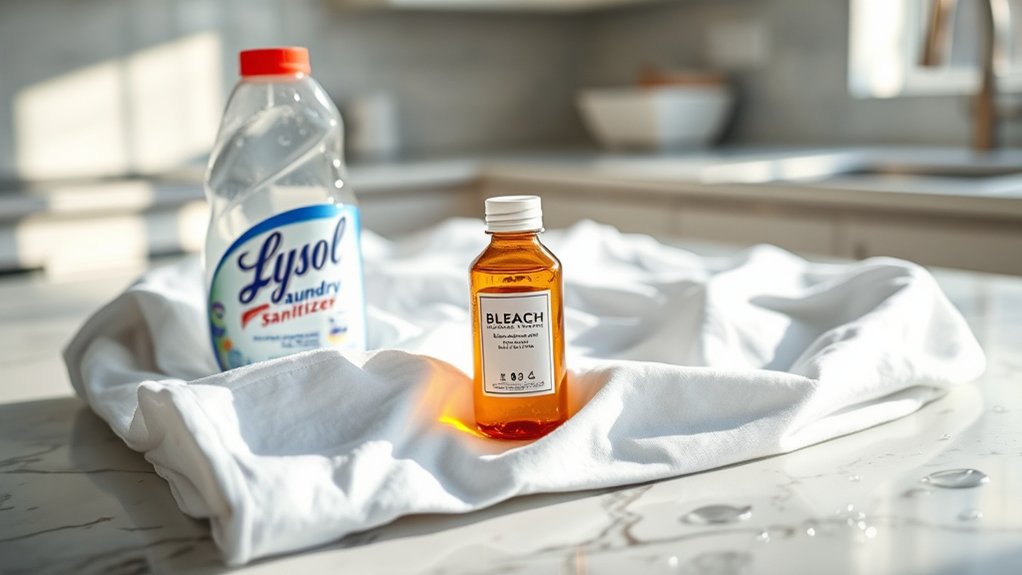
You’ll find that chlorine bleach consistently outperforms Lysol Laundry Sanitizer when it comes to killing germs, especially if you’re using older washing machines or cold water.
Now, Lysol does get more effective if you use warmer water and run longer wash cycles, but even then, it still can’t quite match bleach’s superior disinfecting power.
Knowing these differences can really help you pick the right sanitizer depending on your laundry setup and how clean you want your clothes to be.
Bleach Versus Lysol
When comparing disinfectants in laundry, chlorine bleach consistently outperforms Lysol Laundry Sanitizer in eliminating bacteria.
Bleach remains the gold standard for germ elimination thanks to its broad-spectrum efficacy and rapid action.
Lysol works better with warmer water and longer contact, but it still can’t match bleach’s disinfecting power.
Consider these points:
- Bleach effectively kills a wider range of pathogens than Lysol.
- Lysol reduces bacteria but leaves many survivors when used alone.
- Combining Lysol with detergents slightly improves sanitization but falls short of bleach.
- Bleach is superior for heavy-duty disinfection and thorough microbial control.
If you want maximum bacterial elimination in your laundry, bleach is the more reliable and proven choice compared to Lysol Laundry Sanitizer.
Germ-Killing Performance
While bleach remains the benchmark for disinfecting laundry, understanding how Lysol Laundry Sanitizer measures up helps you make informed choices for germ control. Lysol claims to kill 99.9% of bacteria, yet tests show it’s less effective than chlorine bleach.
Lysol works better with warm water and longer contact times but falls short in heavily soiled loads. It’s gentler on fabrics and can be used in cold water, offering convenience. Pairing Lysol with detergents like Norwex improves results.
Below is a comparison of their germ-killing performance:
| Feature | Lysol Laundry Sanitizer |
|---|---|
| Kill 99.9% of bacteria | Yes (less effective than bleach) |
| Effective Water Temp | Cold and warm |
| Contact Time Required | Longer than bleach |
| Fabric Safety | Gentle |
| Best Use | Lightly soiled, paired with detergent |
You should weigh these factors when choosing your laundry sanitizer.
When and Why to Use Lysol Laundry Sanitizer
Because fabrics like children’s clothes, sportswear, and bedding often harbor harmful bacteria, adding Lysol Laundry Sanitizer to your wash can greatly reduce microbial presence by killing 99.9% of bacteria.
When you’re doing laundry using this sanitizer, consider these key reasons:
- To sanitize items washed in cold water, maintaining fabric integrity while eliminating microbes
- For athletic wear and shoes that retain odor, improving freshness without harsh chemicals
- When washing for individuals with sensitive skin or skin conditions, reducing bacterial irritants
- To enhance hygiene in standard or HE machines by adding 2 capfuls during the rinse cycle or fabric softener compartment
These uses optimize sanitation and odor control, making Lysol Laundry Sanitizer a precise, evidence-based choice for targeted laundry hygiene.
How to Use Lysol Laundry Sanitizer for Best Results
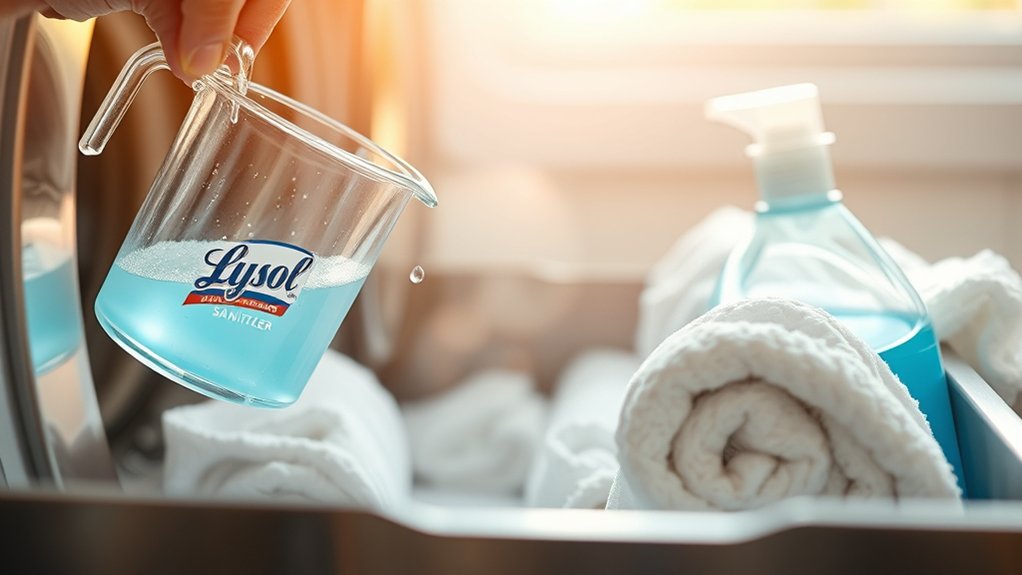
To get the best results with Lysol Laundry Sanitizer, make sure to add exactly two capfuls. You can pour it into your machine’s fabric softener compartment or add it during the rinse cycle.
Also, it’s important that the rinse cycle lasts at least 16 minutes. This gives the sanitizer enough time to work and effectively reduce bacteria.
Proper Dosage Guidelines
Two capfuls of Lysol Laundry Sanitizer added to your washing machine’s fabric softener compartment or during the rinse cycle guarantee excellent sanitization.
Following these proper dosage guidelines ensures you kill bacteria effectively and improve odor elimination, especially in athletic and heavily soiled clothes.
Keep in mind: use 2 capfuls for both standard and HE machines, as per manufacturer instructions.
Add sanitizer during the rinse cycle or fabric softener compartment for maximum contact.
Run the rinse cycle for at least 16 minutes to maximize bacteria reduction.
It works efficiently in cold water and is safe for delicates and colors.
Adhering strictly to these guidelines provides consistent sanitization and leverages Lysol’s full antimicrobial potential.
Best Machine Placement
When you add Lysol Laundry Sanitizer to your washing machine, placing it in the fabric softener compartment or during the rinse cycle maximizes its antimicrobial action.
For both standard and HE machines, use 2 capfuls of Lysol Laundry Sanitizer in these locations to guarantee ideal distribution and efficacy.
The rinse cycle should last at least 16 minutes to allow the sanitizer sufficient contact time to eliminate bacteria effectively.
Integrating Lysol Laundry Sanitizer with your regular detergent not only enhances antimicrobial performance but also improves overall laundry freshness.
Always adhere strictly to the product label instructions, as improper placement or dosing can reduce the sanitizer’s effectiveness.
Optimal Cycle Timing
Although Lysol Laundry Sanitizer is effective in various wash cycles, you’ll achieve the best antimicrobial results by adding 2 capfuls to the fabric softener compartment or during the rinse cycle and confirming the rinse lasts at least 16 minutes. This timing maximizes bacterial kill by allowing sufficient contact.
For ideal use, consider these points:
- Use warmer water to enhance Lysol Laundry Sanitizer’s germicidal action.
- Add sanitizer during sanitize cycles lasting around 1 hour 45 minutes for improved cleanliness.
- Always follow product instructions precisely to confirm efficacy.
- Apply Lysol Laundry Sanitizer in both standard and HE machines via the rinse or softener compartment.
Adhering to these cycle timing strategies guarantees you harness Lysol Laundry Sanitizer’s full antimicrobial potential.
Can You Use Lysol in Any Washing Machine?
How can you guarantee Lysol Laundry Sanitizer works effectively in your washing machine? You can use Lysol in both standard and HE machines by adding 2 capfuls to the fabric softener compartment or directly during the rinse cycle.
For standard machines, verify the rinse cycle runs at least 16 minutes to maximize the sanitizer’s ability to kill germs. Lysol’s formulation works effectively in cold water, making it compatible with cold wash cycles.
It’s safe for various fabrics, including baby clothes and delicates, without causing damage. By strictly following the product instructions, you optimize Lysol’s sanitizing power, verifying it kills bacteria efficiently during the rinse.
Using Lysol correctly guarantees effective sanitization regardless of your washing machine type.
What Independent Tests Show About Lysol
Since maintaining effective hygiene is essential, independent tests have evaluated Lysol Laundry Sanitizer’s ability to reduce bacteria during laundering.
These tests reveal important insights you should consider:
Lysol effectively reduces bacteria, especially with warm water and longer contact times. Using 2 capfuls in the detergent dispenser shows some bacterial reduction, though less than chlorine bleach.
Combining Lysol with Norwex detergent considerably improves bacteria elimination.
Despite claims of killing 99.9% of bacteria, some lawsuits question Lysol’s efficacy under standard laundering conditions.
You can rely on independent data to understand how Lysol enhances sanitation, but note it may not fully match bleach’s germ-killing performance.
These findings help you make informed choices about integrating Lysol into your laundry routine.
Limitations and Alternatives to Lysol Laundry Sanitizer
While Lysol Laundry Sanitizer reduces bacteria effectively under certain conditions, it doesn’t match the disinfection power of chlorine bleach, especially in heavily soiled loads. Lysol’s efficacy depends on warmer water and longer contact time but may still leave bacteria behind.
Chlorine bleach remains superior for killing bacteria on heavily contaminated fabrics.
| Factor | Lysol Laundry Sanitizer |
|---|---|
| Efficacy | Moderate; improved with Norwex detergent |
| Water Temperature | Warmer water enhances results |
| Heavy Soil Loads | Less effective than chlorine bleach |
If you require rigorous disinfection, chlorine bleach is the gold standard. Lysol Laundry Sanitizer can supplement but not replace bleach for thoroughly killing bacteria in laundry.
What the Class Action Dismissal Means for You
The dismissal of the class action lawsuit means that Lysol Laundry Sanitizer’s labeling meets legal standards and matches what most consumers would expect.
So, if you bought the product, especially in states like New York and New Mexico, this ruling limits your options for legal action.
It’s also a good reminder to take a closer look at product claims and understand the difference between cleaning and actual sanitizing when it comes to laundry care.
Legal Ruling Impact
Although the class action lawsuit against Reckitt Benckiser was dismissed, you should understand how this legal outcome affects your rights and expectations regarding Lysol Laundry Sanitizer.
The ruling clarifies that the product’s labeling isn’t legally considered misleading to typical consumers. Claims about killing 99.9% of bacteria stand without direct comparison to standard laundering.
You shouldn’t expect significant efficacy benefits beyond regular laundry methods based on current evidence. Legal protections focus on transparency in advertising rather than guaranteeing enhanced bacterial elimination.
This dismissal highlights that while Lysol Laundry Sanitizer claims bacterial reduction, legal standards require clear, comparative data to establish superiority over standard washing.
As a consumer, you must critically evaluate marketing claims and rely on scientifically substantiated information when appraising product efficacy.
Consumer Protection Insights
Because the class action lawsuit against Reckitt Benckiser was dismissed, you should understand that the court found no basis to claim Lysol Laundry Sanitizer’s labeling misleads consumers about its effectiveness.
The judge determined that the product’s claim of killing 99.9% of bacteria doesn’t imply superiority over standard laundry detergent or washing methods.
No credible evidence linked typical laundering to increased bacterial transmission, which undermines claims of misrepresentation.
If you purchased the product within relevant state statutes of limitations, such as in New York or New Mexico, you were part of the targeted class.
However, this dismissal limits Reckitt Benckiser’s financial liability and underscores the importance of critically evaluating manufacturer claims.
Ultimately, you should assess Lysol Laundry Sanitizer’s benefits relative to conventional laundry detergent based on scientific data rather than marketing assertions.
Final Thoughts: Is Lysol Right for Your Laundry?
How well does Lysol Laundry Sanitizer fit into your laundry routine? If you want a product that works effectively in cold water and can kill the bacteria lingering in your clothes, Lysol Laundry Sanitizer is a solid choice.
Testing confirms it kills 99.9% of bacteria, though it’s not as potent as chlorine bleach for full disinfection.
Its performance improves when paired with Norwex detergent.
Consider these points:
- Adds significant bacteria reduction in cold water cycles
- Suitable for delicate fabrics and baby clothes
- Enhances odor elimination, especially on athletic wear
- Requires at least a 16-minute rinse cycle for best efficacy
If you prioritize sanitization without harsh chemicals, Lysol fits well into your laundry regimen.
Frequently Asked Questions
Is Lysol Laundry Sanitizer Safe for Sensitive Skin?
Yes, Lysol Laundry Sanitizer is generally safe for sensitive skin because it’s formulated to be gentle on fabrics and skin.
It effectively reduces odors without causing irritation, even in cold water washes.
However, since individual reactions vary, you should test it on a small fabric area first.
Users with conditions like eczema have reported relief when using it, but always monitor for any adverse skin responses during initial use.
Can Lysol Laundry Sanitizer Be Used on Baby Clothes?
You can absolutely use Lysol Laundry Sanitizer on baby clothes. It’s like a microscopic army wiping out 99.9% of bacteria without harming delicate fabrics.
It works effectively in cold water, preserving colors and softness. Just add 2 capfuls to the fabric softener compartment during the rinse cycle.
This method guarantees thorough sanitization and odor elimination, making your baby’s clothes fresher and safer without risking irritation or damage.
Does Lysol Laundry Sanitizer Have a Strong Chemical Smell?
Yes, Lysol Laundry Sanitizer has a strong chemical smell due to its active disinfecting ingredients.
You’ll notice an overpowering fragrance that can linger on fabrics even after washing and drying.
This scent is a byproduct of the product’s formulation designed to kill bacteria effectively.
If you’re sensitive to strong odors or prefer milder alternatives, this chemical smell might be off-putting.
Although it signals the sanitizer’s presence and potency in your laundry.
How Does Lysol Affect Fabric Colors and Textures?
Lysol Laundry Sanitizer doesn’t greatly affect fabric colors or textures when used as directed. It’s formulated to kill 99.9% of bacteria without causing fading or damage.
Whether you use it in standard or HE machines, it maintains fabric integrity, even on delicates and colors.
Users report effective odor removal without altering fabric feel or appearance, making it safe for regular use across various laundry types.
Is Lysol Laundry Sanitizer Environmentally Friendly?
Lysol Laundry Sanitizer isn’t environmentally friendly. It contains quaternary ammonium compounds, which show toxicity to aquatic organisms and degrade slowly, increasing environmental persistence.
If you prioritize sustainability, you’ll want to avoid frequent use. Instead, consider eco-certified products or plant-based alternatives with proven biodegradability and lower aquatic toxicity.
Checking for environmental certifications helps guarantee your cleaning choices minimize ecological impact while maintaining hygiene.
Conclusion
You should know Lysol Laundry Sanitizer kills 99.9% of bacteria, making it a powerful addition when regular detergents fall short. While bleach remains more potent against certain pathogens, Lysol offers a safer, fabric-friendly alternative.
Independent tests confirm its effectiveness, but it’s not a catch-all solution. Use it strategically, especially for heavily soiled or germ-prone loads. Understanding its limits guarantees you maximize hygiene without overreliance on any single product.