Does Persil Have Fabric Softener – Quick Answer
Persil detergent usually doesn’t contain fabric softener; it’s designed to clean clothes, not coat fibers for extra softness. You can use a separate softener during the rinse cycle if you want softer-feeling fabrics or less static.
Formulas can vary by product and region, so check your Persil label for softening agents or claims such as “softens fabrics.” Use the recommended amount to avoid residue.
You’ll also find simple ways to check your product and manage static without softener.
Does Persil Have Fabric Softener?
No, Persil laundry detergent doesn’t contain fabric softener. If you’re checking the label because you want softer clothes, treat Persil detergent and fabric softener as separate products.
Persil’s standard laundry detergents clean your clothes, but they don’t include a softening agent that replaces a dedicated fabric softener.
Persil’s standard detergents clean clothes but don’t replace a dedicated fabric softener.
You may see Persil products marketed for freshness, odor control, or stain removal. Those features don’t mean the detergent contains fabric softener.
Check the specific bottle or package, since product names and formulas can vary by type and region.
If you want to soften fabrics during laundry, add a separate fabric softener according to its label, or choose a detergent that explicitly says it includes softener.
Don’t rely on scent or marketing claims alone; read the product details to confirm what you’re buying.
How Persil Cleans Without Softening
Persil uses surfactants and enzymes to lift dirt and stains from your clothes. These ingredients go straight to work breaking down grime, rather than coating the fabric.
Unlike fabric softeners, which leave a smooth layer on the fibers, Persil focuses on cleaning without adding that extra coating.
Persil’s Cleaning Ingredients
Although Persil doesn’t add fabric softener, its detergents use surfactants to lift oils and dirt, enzymes to break down stains, and other cleaning agents to help rinse away residue. These ingredients work together during washing, so you can tackle everyday grime and food spills without relying on a softening additive.
The exact formula may vary by product, but you can check its label for specific ingredients and directions.
| Ingredient type | What it does |
|---|---|
| Surfactants | Loosen oily soil from fabric |
| Enzymes | Target stains such as food |
| Builders | Support cleaning in hard water |
| Cleaning agents | Help suspend and rinse away soil |
Use the recommended dose for your load size and soil level. Too much detergent may leave residue, while too little may not clean effectively.
Follow the package instructions and care labels to get the best wash from your Persil product.
How Softening Differs
Cleaning and softening do different jobs: detergent removes soil, while fabric softener coats fibers to reduce friction and add a softer feel.
Persil focuses on cleaning, so you can use it to lift stains, body oils, and everyday grime from clothes. Its cleaning action doesn’t automatically leave fabric with the coated, slippery feel that a softener provides.
If you want softer-feeling laundry, add a separate fabric softener during the rinse cycle, following the product label.
You can also reduce stiffness by avoiding too much detergent, rinsing thoroughly, and drying clothes promptly. Check garment care labels before using softener, since it may affect towels’ absorbency or certain performance fabrics.
In short, Persil cleans your load, while a separate softening step changes how some fabrics feel.
Does Persil Sell Detergent With Softener?
Yes, Persil sells detergents that include fabric softener, though availability varies by product and region. You may find these options in certain markets or product lines, but Persil’s standard detergents don’t all contain softener.
Choosing a combined formula can simplify laundry day when you want cleaning and a softer feel in one wash. Consider what suits your routine:
- Check local availability: You might see different Persil ranges depending on where you shop.
- Compare formats: Combined formulas may come as liquid or another detergent type.
- Think about your laundry: A softening detergent may suit everyday clothes and towels.
- Choose based on preference: If you want more control over softness, you can use detergent and softener separately.
Product options change, so don’t assume every Persil detergent offers the same benefits.
How Can You Check Your Persil Label?
To check your Persil label, start by looking at the ingredients list for any softening agents.
You can also keep an eye out for fabric-softener symbols on the packaging.
Plus, make sure to read the product instructions carefully to understand exactly how the detergent works.
Check the Ingredients
To find out whether your Persil detergent includes fabric softener, read the ingredients and product claims on the label. Check the wording on your specific bottle or box, since formulas can vary by product and region.
- Scan the ingredient list for terms such as “fabric softener,” “softening agent,” or “conditioning agent.” These may indicate a softening ingredient, though names can vary.
- Read the front and back claims. Phrases like “softens fabrics” or “detergent and softener” can clarify what the product promises.
- Don’t assume that “fresh,” “gentle,” or “silky” means softener is included; those words may describe fragrance or cleaning results.
- If the ingredients or claims aren’t clear, check Persil’s official product page or contact the manufacturer with the exact product name.
Always use the label for your particular detergent.
Look for Softener Symbols
The ingredient list and product claims are useful, but symbols can offer another clue. Check the front and back of your Persil package for a fabric-softener icon, such as a soft towel, a flower, or a bottle paired with clothing.
A clear softener symbol may indicate that the formula includes a softening benefit, but don’t assume every decorative image makes that claim. Look for nearby wording that explains what the icon means, and check whether it describes softness, freshness, or another feature.
Packaging can vary by country, product type, and formula, so compare the symbol with the exact product name and label details.
If you don’t see a softener symbol, that alone doesn’t prove the detergent lacks softening ingredients. Use the label’s explicit claims to judge what the product offers.
Read Product Instructions
Although front-label claims can suggest whether Persil offers a softening benefit, the instructions on the back can clarify how the detergent is meant to work.
Turn the bottle or box over and check the directions, ingredients, and care notes. Look for wording that specifically mentions fabric softener, softness, or a separate softening step. Don’t assume that a fresh scent or clean-feeling clothes means the detergent contains softener.
- Read the directions: Check whether Persil tells you to add another product during the rinse cycle.
- Scan the ingredients: Note any listed softening agents, if provided.
- Check the product name: Confirm whether you have standard detergent or a Persil product marketed with added softening benefits.
- Follow the dosage: Use the stated amount; extra detergent won’t make fabrics softer.
If the label’s unclear, check Persil’s official product page.
Can You Use Persil With Fabric Softener?
Yes, you can use Persil with fabric softener. Persil cleans your clothes, while fabric softener adds softness and may reduce static cling. The products serve different purposes, so you can use both in the same laundry load if you want the added benefits.
Choose a softener that suits your fabrics and follow the care labels on your clothes. Some items, such as towels, athletic wear, and flame-resistant garments, may perform better without softener because it can affect absorbency, moisture-wicking, or protective properties.
If you’re unsure, check the garment’s care instructions before using it.
Use the recommended amount of each product. Adding extra detergent or softener won’t necessarily improve results and may leave residue on fabrics.
You can also skip softener if you prefer Persil’s cleaning performance without an added fragrance or conditioning effect.
When Should You Add Fabric Softener?
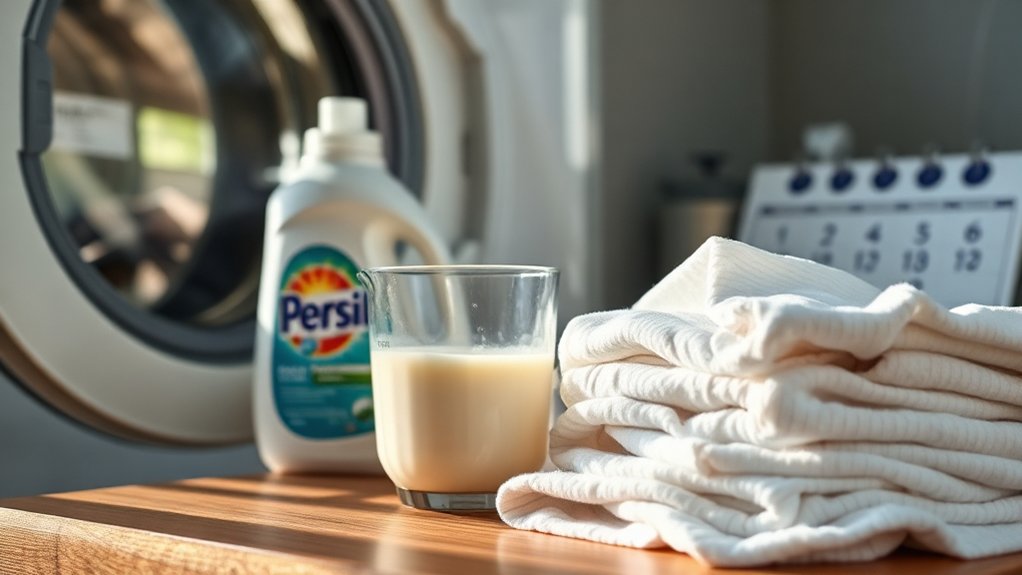
Add fabric softener during the rinse cycle, not when you pour in Persil. Your detergent needs to wash first; softener works later, coating fibers as the machine rinses.
Use your washer’s dispenser if it has one, and fill only to the marked line. The machine releases the product at the right time, so you don’t have to track the cycle.
- Front-loading washer: Pour softener into the labeled compartment before starting the load.
- Top-loader with dispenser: Add it to the designated cup, following the fill marks.
- No dispenser: Wait for the rinse cycle, then dilute the softener with water and add it as your manual advises.
- Hand-washing: Add softener to the final rinse water after removing detergent, then soak and rinse as directed.
Check your washer and product labels for specific instructions.
How Can You Reduce Static Without Softener?
You can reduce static without fabric softener by lowering dryer heat, removing clothes while they’re slightly damp, and avoiding over-drying. These steps limit friction, which creates static cling.
Separate synthetic fabrics, such as polyester, from natural fibers like cotton; synthetics tend to build up more static.
You can also dry smaller loads so clothes have room to tumble without rubbing excessively.
For an extra measure, toss a clean, damp washcloth into the dryer during the last 10 minutes. It adds a little moisture without coating your garments.
Air-drying clothes can help, too, especially delicate items that don’t need machine drying.
If static persists, touch a metal hanger to the garment or lightly mist it with water. Don’t use too much moisture, since damp clothes can encourage mildew.
Frequently Asked Questions
Is Persil Safe for Sensitive Skin?
Persil may irritate sensitive skin, so you should choose carefully. Some Persil detergents contain fragrance, enzymes, or other ingredients that can trigger reactions, though formulas vary by product and country.
Check the label for fragrance-free options, and follow the dosage instructions to avoid residue.
You can also run an extra rinse and test a small load first.
If irritation continues, stop using it and ask a healthcare professional for advice.
Can Persil Be Used in High-Efficiency Washers?
Yes, you can use Persil in a high-efficiency (HE) washer as long as you choose a formula labeled HE-compatible.
These detergents produce fewer suds, which helps your machine clean effectively and drain properly.
Check the bottle for the HE symbol, then follow its dosing instructions.
HE washers usually need less detergent than traditional models.
Don’t pour in extra for a larger load unless the label recommends it since excess detergent can leave residue.
Does Persil Work in Cold Water?
Yes, Persil works in cold water, so you can give chilly washes a fresh start.
Most Persil detergents are formulated to clean effectively in cold cycles, helping you tackle everyday dirt while using less energy.
For best results, follow the instructions on your specific product and measure the recommended amount.
Pretreat stubborn stains, avoid overloading your washer, and choose a cold-water cycle suited to your fabrics.
You’ll get clean clothes without turning up the heat.
Is Persil Suitable for Washing Baby Clothes?
Yes, you can use Persil to wash baby clothes, but check the product label and your baby’s skin sensitivity first.
Choose a fragrance-free, dye-free detergent if your baby has sensitive skin or eczema, since scented formulas may irritate some babies.
Use the recommended amount, rinse clothes thoroughly, and wash new garments before your baby wears them.
If irritation develops, stop using the detergent and ask your pediatrician for advice about a gentler option.
Can Persil Remove Tough Stains?
Yes, Persil can remove tough stains, though that mud won’t politely vanish just because you glare at it.
Pretreat the mark with a little liquid detergent, then wash the garment using the warmest water allowed by its care label.
For stubborn stains, let the detergent sit briefly before washing, and check the result before drying.
Heat can set leftover marks. Choose a Persil formula suited to your fabric and follow its label.
Conclusion
Persil cleans your clothes like a skilled gardener tending a plot: it lifts away dirt, but it doesn’t automatically soften every bloom. Check your label to see whether your bottle includes softener.
If you want extra softness or less static, add fabric softener separately following its instructions or try dryer balls. Choose the care your clothes need, and you’ll help each load leave the laundry garden clean, comfortable, and ready to wear.