What Kills C Diff In Laundry – Simple Breakdown
You can’t rely on ordinary home laundry cycles to kill C. diff spores because they don’t reach the required 160°F (71°C) for at least 25 minutes or use effective sporicidal agents like chlorine bleach.
A cold pre-wash removes soil before high-heat washing with bleach or similar disinfectants guarantees spore inactivation. Drying alone won’t kill spores, so thorough washing and handling protocols are essential.
Understanding these steps will help you manage and prevent contamination effectively.
Key Takeaways
- Washing laundry at 160°F (71°C) for at least 25 minutes is essential to kill C. diff spores effectively.
- Chlorine bleach at 125-150 ppm or EPA-registered sporicidal agents like peracetic acid help inactivate C. diff spores during washing.
- Cold pre-wash removes soil and prevents heat-induced spore protection, optimizing disinfection efficacy.
- Dryer heat alone cannot kill C. diff spores; thorough disinfection requires both high-temperature washing and drying.
- Proper handling of contaminated linens with sealed biohazard bags and trained personnel prevents cross-contamination and infection spread.
Why Regular Washing Fails to Kill C. Diff Spores
Although you might assume that regular washing removes all harmful germs, standard laundry cycles fail to kill C. diff spores because they don’t reach the necessary temperature of at least 160°F (71°C) for a sustained period of 25 minutes. Most home machines max out at 130°F (54°C), which is insufficient for effective laundry disinfection.
Furthermore, routine detergents lack the sporicidal properties needed to inactivate these resilient spores. Without EPA-registered sporicidal disinfectants like chlorine bleach, spore contamination persists, increasing infection risk.
Improper timing of bleach addition further reduces its efficacy against spores. As a result, conventional laundry practices can inadvertently spread C. diff contamination instead of eliminating it, underscoring the critical need for specialized protocols tailored to address these hardy pathogens.
Effective Temperatures and Chemicals to Kill C. Diff
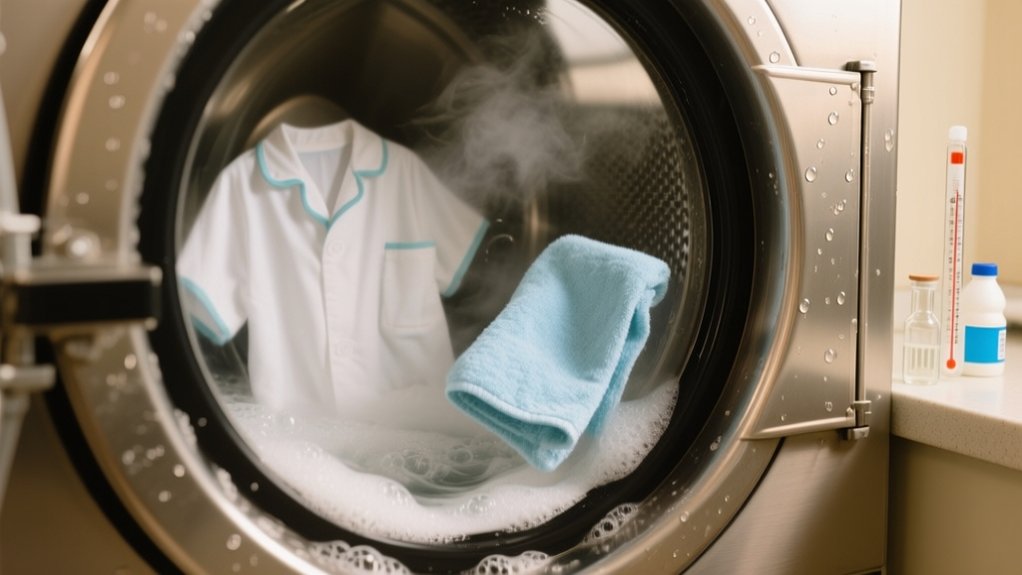
When you want to eliminate C. diff spores from laundry, you need to use water heated to at least 160°F (71°C) and maintain that temperature for a minimum of 25 minutes. This thermal exposure guarantees up to 99.9999% spore inactivation.
Effective chemical agents are essential too. Chlorine bleach at 125-150 ppm and peracetic acid are EPA-registered sporicidal disinfectants proven to kill C. diff spores.
Chlorine bleach and peracetic acid are EPA-approved sporicidal agents effective against C. diff spores.
Before the main wash, a cold pre-wash removes gross soil without setting protein stains, optimizing disinfection.
Combining high temperature with these chemicals achieves a high log reduction of spores that standard home washers can’t deliver.
For reliable C. diff eradication in laundry, you must integrate both precise temperature control and the correct sporicidal agents like chlorine bleach or peracetic acid.
Why Home Washers Can’t Kill C. Diff Spores
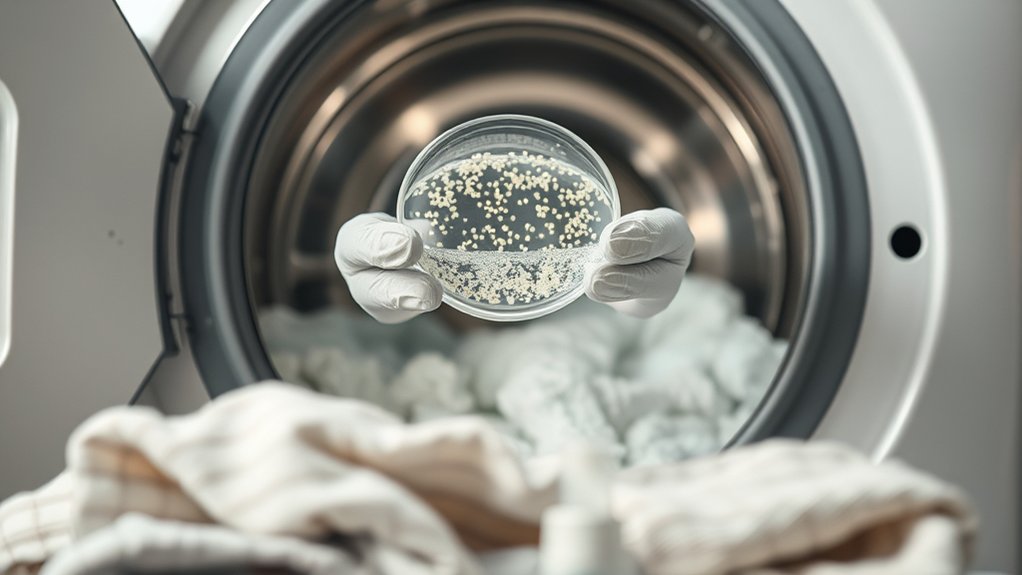
Since home washers typically don’t reach temperatures above 130°F (54°C), they can’t inactivate C. diff spores. These spores require at least 160°F (71°C) for effective thermal disinfection. The spores have a resilient protective shell that standard residential wash cycles can’t penetrate.
Instead of killing spores, home washers often spread them, which increases the risk of contamination. Also, effective sporicidal disinfectants kill C. diff only when used at validated concentrations, like EPA-registered chlorine bleach. Most home settings don’t use these.
Professional laundry protocols combine sustained high heat with appropriate chemical use to achieve a 99.9999% reduction in spores. These are conditions that home washers can’t replicate.
Safe Handling and Containment of C. Diff Linens
Properly handling and containing C. diff-contaminated linens is essential to prevent the spread of spores through aerosolization or direct contact. For safe handling, always use impermeable, leak-proof biohazard bags to contain soiled linens. Seal them securely to avoid spillage during transport.
Follow strict containment protocols by using dedicated, non-porous, clearly labeled carts. This helps maintain a secure chain of custody and minimizes exposure risks.
Personnel must be trained thoroughly in these protocols, ensuring compliance with OSHA standards and reinforcing public health safety.
Sticking to these safe handling and containment protocols in healthcare environments greatly reduces the risk of cross-contamination. It also helps manage the spread of C. difficile infections effectively.
Your diligence in these steps is key to controlling C. diff in laundry processes.
The Importance of a Cold Water Pre-Wash for C. Diff
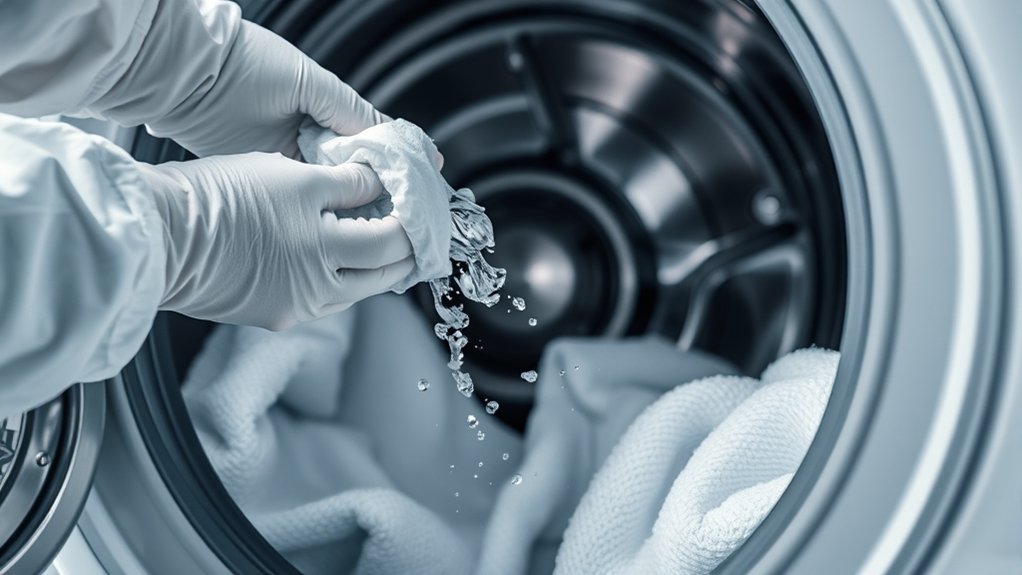
Although many might overlook it, a cold water pre-wash plays a vital role in managing C. diff-contaminated linens. This initial flush cycle removes gross soil and prevents protein stains from setting, which is essential for enhancing disinfection efficacy.
Using cold water guarantees spores aren’t shielded by heat-induced coagulation, allowing disinfectants to work effectively during the main wash. This step loosens contaminants, preparing linens for the subsequent high-temperature cycle that kills C. diff spores.
Key benefits of a cold water pre-wash include:
- Removes visible soil without setting stains
- Prevents shielding of spores from disinfectants
- Prepares fabrics for effective main wash
- Enhances overall disinfection efficacy
- Supports compliance with healthcare laundering protocols
Incorporate a cold water pre-wash to optimize your laundering process against C. diff.
Using Bleach to Kill C. Diff Spores
When you add chlorine bleach to your laundry, you target C. diff spores with a proven disinfectant that requires a concentration of 125-150 ppm in the wash water. You should add bleach after the machine fills and detergent mixes to maintain effectiveness.
Confirm water temperature is at least 160°F (71°C) for 25 minutes to thermally inactivate Clostridioides difficile spores. Keep your washing machine clean to avoid contamination.
| Parameter | Requirement | Rationale |
|---|---|---|
| Bleach concentration | 125-150 ppm | Effective spore disinfection |
| Addition timing | After fill and detergent mix | Prevents bleach neutralization |
| Water temperature | ≥160°F (71°C) | Thermal inactivation |
| Duration | Minimum 25 minutes | Confirms complete spore kill |
| Machine cleanliness | Thoroughly clean before use | Avoids cross-contamination |
How Commercial Laundry Protocols Ensure C. Diff Disinfection
Since Clostridioides difficile spores resist many standard cleaning methods, commercial laundry protocols use rigorous processes to guarantee effective disinfection. The commercial laundry process relies on a combination of heat, chemicals, and mechanical action to inactivate spores reliably.
Clostridioides difficile spores require rigorous commercial laundry methods combining heat, chemicals, and mechanical action for effective disinfection.
Key steps include:
- Maintaining water temperatures at 160°F (71°C) for at least 25 minutes to kill spores
- Using EPA-registered sporicidal disinfectants like chlorine bleach at 125-150 ppm
- Implementing a cold pre-wash cycle to remove gross soil and prevent stain setting
- Employing multiple rinse cycles and vigorous agitation for superior pathogen reduction
- Utilizing launderable barriers in healthcare settings to protect surfaces and support infection control
Why Drying Alone Can’t Kill C. Diff Spores
You can’t just rely on drying alone to kill C. diff spores. That’s because the heat from a typical dryer doesn’t get hot enough to break through their tough, resilient shell.
The real key is the wash cycle. During washing, the water temperature combined with sporicidal agents, like bleach, work together to effectively inactivate those spores.
Drying is more like a backup step—it helps, but it can’t replace proper washing protocols.
Limitations Of Dryer Heat
Although dryers can reach high temperatures capable of inactivating some residual C. diff spores, relying on drying alone won’t guarantee complete disinfection.
Dryer heat alone lacks the sustained exposure and chemical action necessary for extensive microbial kill.
The disinfection process requires a primary wash cycle with high heat and sporicidal agents to effectively neutralize C. diff spores.
Drying serves only as a supplementary step and can’t replace the critical role of washing.
Keep in mind:
- Dryer heat temperatures are often insufficient in duration to kill all spores
- Effective disinfection demands exposure to ≥160°F (71°C) during washing
- Sporocidal agents like chlorine bleach are essential in the wash cycle
- Drying can’t compensate for inadequate washing protocols
- Thorough disinfection relies on combining washing and drying steps
Importance Of Wash Cycle
When tackling C. diff spores in laundry, relying on drying alone won’t get you the disinfection results you need. Effective wash cycles are vital to kill C. diff spores because drying temperatures simply don’t reach the minimum 160°F (71°C) required for inactivation.
You must confirm your main wash cycle sustains high heat for at least 25 minutes. Moreover, incorporating chlorine bleach at 125-150 ppm during this cycle is necessary to disrupt the resilient spores.
Standard residential machines often fall short, so verify your washer’s capabilities and use sporicidal agents accordingly.
Dryer As Secondary Step
One key reason why drying alone can’t kill C. diff spores is that the heat generated in a dryer doesn’t reach or sustain the minimum 160°F (71°C) for 25 minutes required for effective spore inactivation.
While the dryer adds supplemental heat, it doesn’t provide sufficient disinfection on its own.
You must rely primarily on the wash cycle with hot water and bleach for spore elimination. The dryer acts as a secondary step, helping reduce residual spores but never replacing thorough washing.
Remember these points about the dryer’s role in C. diff disinfection:
- Dryer heat is insufficient alone for spore kill
- Primary disinfection occurs during washing
- Drying offers an added safety layer
- Spores resist heat without chemical action
- Complete protocols combine wash and dryer steps
Use the dryer as a safeguard, not your sole disinfection method.
When to Call Professionals for C. Diff Laundry Remediation
If you encounter extensive C. diff contamination or find spores embedded in carpets or upholstery, you should call in professional biohazard remediation experts. Their specialized equipment and knowledge guarantee effective decontamination beyond what residential methods offer.
Professional intervention becomes essential when dealing with laundry chemicals and disinfection protocols that home machines can’t match. Commercial-grade washers reach the necessary 160°F (71°C) for killing spores.
Trained teams follow strict procedures, including washing machines’ post-cleaning with bleach to prevent cross-contamination.
In addition, professionals assure compliance with health regulations, minimizing infection risks, especially in healthcare settings.
When C. diff contamination surpasses simple laundry, relying on experts protects your environment and guarantees thorough remediation. Don’t hesitate to engage professionals for critical biohazard situations.
Frequently Asked Questions
Can C. Diff Spores Survive on Clothing After Laundering?
Yes, C. diff spores can survive on clothing after laundering if you don’t use the right methods.
Standard washing temperatures and detergents alone won’t eliminate these hardy spores.
To effectively kill them, you need to wash at a minimum of 160°F for at least 25 minutes and include an EPA-registered sporicidal disinfectant like chlorine bleach at the proper concentration.
Otherwise, spores can persist and risk cross-contamination.
How Long Do C. Diff Spores Remain Infectious on Fabric?
C. diff spores can remain infectious on fabric for up to 60 days if you don’t properly disinfect them. Their tough protective shell lets them survive harsh conditions, including regular washing.
To guarantee you eliminate them, you need to apply specific high-temperature laundering and chemical treatments.
Otherwise, those spores can cling to textiles for weeks or even months, posing a serious infection risk long after contamination.
Are There Any Natural or Eco-Friendly Chemicals Effective Against C. Diff?
You won’t find any natural or eco-friendly chemicals that reliably kill C. diff spores on their own.
While substances like tea tree oil, essential oils, vinegar, and low-concentration hydrogen peroxide show some antimicrobial effects, they don’t fully inactivate spores.
To effectively disinfect laundry contaminated with C. diff, you need proven sporicidal agents like bleach.
You can use eco-friendly products for hygiene maintenance but never rely on them exclusively against C. diff.
What Personal Protective Equipment Is Needed When Handling C. Diff Laundry?
You need impermeable gloves, fluid-resistant gowns, and masks when handling C. diff laundry.
Gloves protect your hands from direct contact with spores, while gowns shield your arms and body from contamination.
Masks or respirators prevent inhaling aerosolized spores.
Always follow strict PPE protocols and training to avoid cross-contamination.
Proper donning and disposal of this equipment guarantee your safety and reduce the risk of spreading C. diff during laundry handling.
Can Repeated Laundering Damage Fabrics Treated for C. Diff Disinfection?
Yes, repeated laundering can damage fabrics treated for C. diff disinfection.
High temperatures above 160°F and bleach concentrations around 125-150 ppm effectively kill spores but also cause fabric degradation over time.
You’ll notice reduced durability and visible wear with frequent exposure to these harsh conditions.
To protect your textiles, choose materials designed for heavy chemical and heat resistance.
Balance disinfection protocols with fabric longevity to maintain both effectiveness and durability.
Conclusion
When tackling C. diff in laundry, you can’t just wash and hope for the best. Regular cycles often leave spores intact, so you need high temperatures paired with bleach or specialized chemicals to truly kill them.
Remember, home washers aren’t built for this battle. Commercial protocols handle it like pros. Don’t let this problem slip through the cracks.
When in doubt, call professionals. In this fight, cutting corners is like leaving the door wide open for trouble.